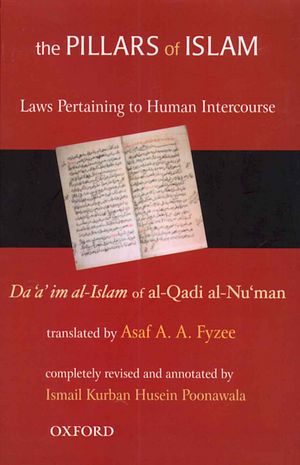
Pillars of Islam: Volume 2. Laws Pertaining to Human Intercourse

Subjects:
Islamic Law
Contents:
TRANSLITERATION
LIST OF ABBREVIATIONS
EDITOR'S INTRODUCTION

1. Book of Business Transactions and Rules Concerning Them

2. The Book of Oath and Vows

3. The Book of Food

4. Book of Drinks

5. Book of Medicine

6. Book of Dress and Perfume

7. Book of Hunting

8. Book of Ritual Slaughter

9. Book of Sacrificial Animals and the Offerings made for Newborn Children

10. Book of Marriage

11. Book of Divorce

12. Book of the Emancipation of Slaves

13. Book of Benefactions

14. Book of Wills

15. Book of Inheritance

16. Book of Bloodwit

17. Book of Divinely Ordained Punishments

18. Book of Thieves and Robbers

19. Book of Apostasy and Innovation

20. Book of Usurpation and Transgression

21. Book of Commodate Loans and Deposits

22. Book of Finds, The Foundling and the Runaway Slave

23. Book of Partition and Construction

24. Book of Evidence

25. Book of Claims and Clear Proofs

26. Book of the Etiquette of Qadis
GLOSSARY
BIBLIOGRAPHY OF CITED WORKS
INDEX
INDEX OF QUARANIC VERSES

ISBN13: 9780195667844
ISBN: 0195667840
Published: January 2004
Publisher: Oxford University Press
Binding: Hardback
Price: £35.99

The Pillars of Islam, was the culmination of Nu'man's efforts in the field of jurisprudence for more than thirty years. It was commissioned by the Fatimid caliph al Mu'izz-Din Allah and was officially promulgated as the state code. The judicial and legal system constructed in The Pillars, both for use of the state as well as the Isma'ili community is, therefore, unique, and Nu'man is rightly considered as its founder. The Pillars is considered by the Musta'li-Tayyibi Bohras as the greatest authority on Isma'ili law and has until today remained as the greatest authority in the legal matters. It is also applied by courts in the Indo-Pakistan subcontinent in personal and family matters as the Isma'ili law manual. The second volume of The Pillars of Islam deals more precisely with the law than the first volume. It deals with a wide range of subjects such as food, dress, medicine, oaths, hunting, business transactions, loans, partition and construction, evidence, marriage, divorce, wills, inheritance, criminal punishments, question of apostasy and etiquette of judges. An essential buy for all libraries and institutions that buy books on Islamic law/studies. This is an essential reading