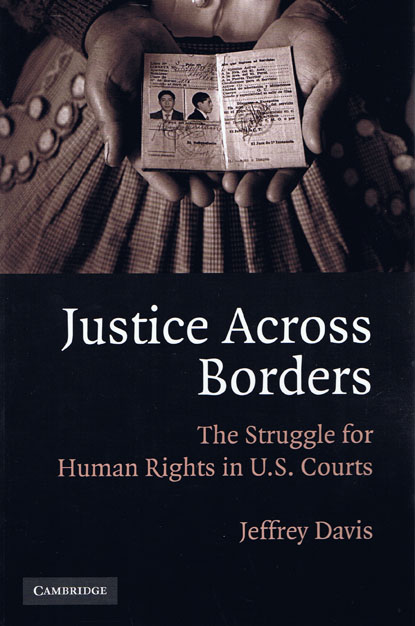
Justice Across Borders: The Struggle for Human Rights in U.S. Courts

Subjects:
Human Rights and Civil Liberties
Contents:
1. The seeds of legal accountability

2. Competing forces in the struggle for accountability

3. Human rights entrepreneurs: NGOs and the ATS revolution

4. Separation of powers and human rights cases

5. No safe haven: human rights cases challenging foreign countries and nationals

6. Holding corporations accountable for human rights violations

7. Sorting through the ashes: testing findings and predictions through quantitative analysis

8. Impact and conclusion.

ISBN13: 9780521702409
ISBN: 0521702402
To be Published: August 2008
Publisher: Cambridge University Press
Country of Publication: UK
Binding: Paperback
Price: £17.99 - Not Yet Published
Hardback edition not yet published, ISBN13 9780521878173

This book studies the struggle to enforce international human rights law in federal courts. In 1980, a federal appeals court ruled that a Paraguayan family could sue a Paraguayan official under the Alien Tort Statute – a dormant provision of the 1789 Judiciary Act – for torture committed in Paraguay. Since then, courts have been wrestling with this step toward a universal approach to human rights law. Davis examines attempts by human rights groups to use the law to enforce human rights norms. He explains the separation of powers issues arising when victims sue the United States or when the United States intervenes to urge dismissal of a claim and analyses the controversies arising from attempts to hold foreign nations, foreign officials, and corporations liable under international human rights law. While Davis’s analysis is driven by social science methods, its foundation is the dramatic human story from which these cases arise.


  • First comprehensive study of international human rights cases brought in U.S. courts under the Alien Tort Statute and Torture Victim Protection Act
  • Will be compelling to scholars and students from numerous fields: human rights, American politics, U.S. foreign policy, interest groups, etc.
  • Uses a mix of social science methods and legal analysis grounded in the extraordinary human stories from which these cases arise