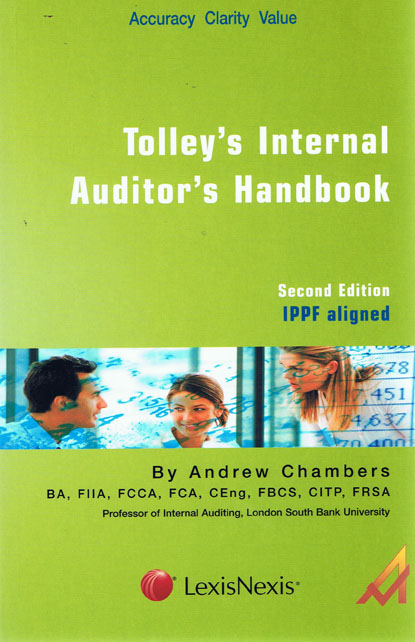
Tolley's Internal Auditor's Handbook 2nd ed

Subjects:
Butterworths Handbooks, Company Law
Contents:
Part A - Internal audit attributes
Chapter A1.1 Understanding internal auditing –
best practice guidance
Chapter A1.2 Understanding internal auditing –
supplementary guidance
Chapter A1.3 Understanding internal auditing –
case studies
Chapter A2.1 Internal audit independence and objectivity –
best practice guidance
Chapter A2.2 Internal audit independence and objectivity –
supplementary guidance
Chapter A2.3 Internal audit independence and objectivity –
case studies
Chapter A3.1 Proficiency and care in internal auditing –
best practice guidance
Chapter A3.2 Proficiency and care in internal auditing –
supplementary guidance
Chapter A3.3 Proficiency and care in internal auditing –
case studies
Chapter A4.1 Quality assurance and improvement programme –
best practice guidance
Chapter A4.2 Quality assurance and improvement programme –
supplementary guidance
Part B - Performing internal audit
Chapter B1.1 Managing the internal audit activity –
best practice guidance
Chapter B1.2 Managing the internal audit activity –
supplementary guidance
Chapter B1.3 Managing the internal audit activity –
case studies
Chapter B2.1 Nature of work –
best practice guidance
Chapter B2.2 Nature of work –
supplementary guidance
Chapter B2.3 Nature of work –
case studies
Chapter B3.1 Engagement planning –
best practice guidance
Chapter B3.2 Engagement planning –
case studies
Chapter B4.1 Performing the engagement –
best practice guidance
Chapter B4.2 Performing the engagement –
supplementary guidance
Chapter B4.3 Performing the engagement –
case studies
Chapter B5.1 Communicating results –
best practice guidance
Chapter B5.2 Communicating results –
supplementary guidance
Chapter B5.3 Communicating results –
case studies
Chapter B6.1 Monitoring progress –
best practice guidance
Chapter B7.1 Resolution of management’
s acceptance of risks –
best practice guidance
Chapter B7.2 Resolution of management’
s acceptance of risks –
case studies
Part C - Selected advanced audit engagements
Chapter C1: The internal audit role in mergers and acquisitions
Chapter C2: Auditing subsidiaries and remote operating units
Chapter C3: Outsourced business activities, and implications for internal audit
Chapter C4: Reputational risk –
control and audit
Chapter C5: Information technology
Chapter C6: Contracting
Appendices
Appendix 1 - The Institute of Internal Auditors Code of Ethics
Appendix 2 - International Standards for the Professional Practice of Internal Auditing
Appendix
3.1 - Practice Advisories by Standard number
Appendix
3.2 - Index to IIA Practice Advisories –
by topic
Appendix 4 - Government Internal Audit Standards
Appendix 5 - Content Specification Outlines for the Certified Internal Auditor professional qualification of The Institute of Internal Auditors
Appendix 6 - Certification in Control Self Assessment of The Institute of Internal Auditors
Appendix 7 - The Institute of Internal Auditors (UK) Practitioner of The Institute of Internal Auditors Programme –
outline and contents
Appendix 8 - The Institute of Internal Auditors (UK) Member of The Institute of Internal Auditors Programme –
outline and contents
Appendix 9 - Websites for internal auditors

ISBN13: 9781405735674
ISBN: 1405735678
To be Published: December 2008
Publisher: LexisNexis Butterworths
Country of Publication: UK
Binding: Paperback
Price: £89.95 - Not Yet Published

The most comprehensive guide to internal audit available, this book is a must have for internal audit departments and an ideal resource for external advisors.

The second edition is vastly expanded and includes the very latest Institute of Internal Auditors Standards and also includes short chapters giving insights into particular sectors – financial services, including banking, government, including local authorities, charities and small IA teams.

This detailed handbook takes in the theory (Part A) and practice (Part B) of internal auditing, and includes chapters on specialist areas such as IT and environmental auditing. As well as looking at the complete process – from planning to report writing and beyond – this title examines the principles and purpose of the internal audit, taking in independence, objectivity and quality assurance.
The handbook’s structure corresponds to the structure of the Institute of Internal Auditors’ Standards – which have been adopted throughout the world including within the UK and are the foundations of the international Certified Internal Auditor (CIA) and UK examinations (PIIA and MIIA). Apart from being a practitioner guide for use anywhere in the world, the handbook also sets out to be a textbook to assist trainees to pass these exams.