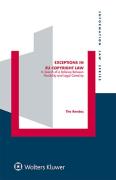
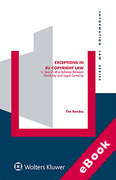
The three-step test - by which limitations on exclusive copyrights are confined to 'certain special cases' which do not conflict with a 'normal exploitation of the work' and do not 'unreasonably prejudice the legitimate interests of the author' - is among the most enduring of standards affecting limitations on intellectual property rights. Its field of application is the delicate balance between exclusive rights and sufficient breathing space for the free flow of ideas and information. However, the emerging information society has thrown numerous unforeseen obstacles in the once-clear path of its implementation. Can the traditional balance between grants and reservations of copyright law be recalibrated along the lines of the three-step test in order to meet current and future needs? Controversies over this crucial question - in Europe, the U.S., Australia, and elsewhere, as well as in two significant WTO panels in 2002 - have brought the three-step test into focus, the essential principle governing copyright limitations in the information society.
The author provides many examples that demonstrate the test's impact on different types of limitations, such as private use privileges and the U.S. fair use doctrine. He explains the test's role in the European Copyright Directive. The detailed examination and explanation of the three-step test will be of extraordinary value to policymakers, judges, and lawyers in the field of intellectual property law seeking to react adequately to the challenges of the digital environment.
Due to a technical issue some ebooks are not available to order.
Due to a technical issue some ebooks are not available to order.
Due to a technical issue some ebooks are not available to order.
Due to a technical issue some ebooks are not available to order.
Due to a technical issue some ebooks are not available to order.