
The eBooks we sell are sold as a single-user licence and are intended for the end user only.
The sale of some eBooks are restricted to certain countries. To alert you to such restrictions, please select the country of the billing address of your credit or debit card you wish to use for payment.
For further information see https://www.wildy.com/ebook-formats
Once the order is confirmed an e-mail will be sent to you to allow you to download the eBook. For UK purchases this will be automatic. For purchases outside the UK a member of staff will need to confirm the sale. (Staff are available to do this during normal business hours, Mon-Fri 8:30-17:00 UK time)
All eBooks are supplied firm sale and cannot be returned. If you believe there is a fault with your eBook then contact us on ebooks@wildy.com and we will help in resolving the issue. This does not affect your statutory rights.
Fact-finding is at the heart of human rights advocacy, and is often at the center of international controversies about alleged government abuses.
In recent years, human rights fact-finding has greatly proliferated and become more sophisticated and complex, while also being subjected to stronger scrutiny from governments. Nevertheless, despite the prominence of fact-finding, it remains strikingly under-studied and under-theorized. Too little has been done to bring forth the assumptions, methodologies, and techniques of this rapidly developing field, or to open human rights fact-finding to critical and constructive scrutiny.
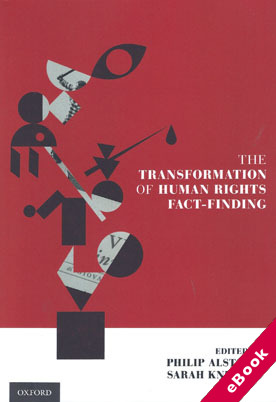
The Transformation of Human Rights Fact-Finding offers a multidisciplinary approach to the study of fact-finding with rigorous and critical analysis of the field of practice, while providing a range of accounts of what actually happens.
It deepens the study and practice of human rights investigations, and fosters fact-finding as a discretely studied topic, while mapping crucial transformations in the field. The contributions to this book are the result of a major international conference organized by New York University Law School's Center for Human Rights and Global Justice. Engaging the expertise and experience of the editors and contributing authors, it offers a broad approach encompassing contemporary issues and analysis across the human rights spectrum in law, international relations, and critical theory.
This book addresses the major areas of human rights fact-finding such as victim and witness issues; fact-finding for advocacy, enforcement, and litigation; the role of interdisciplinary expertise and methodologies; crowd sourcing, social media, and big data; and international guidelines for fact-finding.










