
The eBooks we sell are sold as a single-user licence and are intended for the end user only.
The sale of some eBooks are restricted to certain countries. To alert you to such restrictions, please select the country of the billing address of your credit or debit card you wish to use for payment.
For further information see https://www.wildy.com/ebook-formats
Once the order is confirmed an e-mail will be sent to you to allow you to download the eBook. For UK purchases this will be automatic. For purchases outside the UK a member of staff will need to confirm the sale. (Staff are available to do this during normal business hours, Mon-Fri 8:30-17:00 UK time)
All eBooks are supplied firm sale and cannot be returned. If you believe there is a fault with your eBook then contact us on ebooks@wildy.com and we will help in resolving the issue. This does not affect your statutory rights.
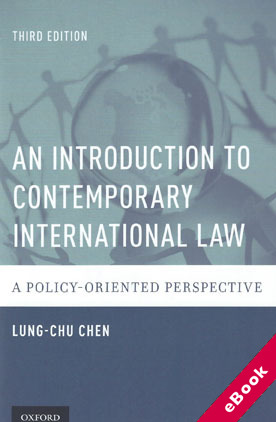
An Introduction to Contemporary International Law: A Policy-Oriented Perspective introduces the reader to all major aspects of contemporary international law.
It applies the highly acclaimed approach developed by the New Haven School of International Law, viewing international law as an ongoing process of decision-making through which the members of the world community identify, clarify, and secure their common interests.
Unlike conventional works in international law, this work is organized and structured in terms of the process of decision making in the international arena, and references both classic historical examples and contemporary events to illustrate international legal processes and principles. Using contemporary examples, this Third Edition builds on previous editions by contextualizing and dramatizing these changes with reference to seven features that characterize the New Haven School approach to international law: participants, perspectives, arenas of decision, bases of power, strategies, outcomes, and effects.
This new edition highlights the major developments in international law since 2000, including the right to self-determination, the expanding scope of international concern and the duty of states to protect human rights, the trend towards greater accountability for states and individual decision-makers under international law, and the vital role individual responsibility plays in the emerging field of international criminal law. It provides a new generation of students with the interest and the intellectual tools needed to participate as responsible members of a world community premised on the notion of human dignity for all people.










