
The eBooks we sell are sold as a single-user licence and are intended for the end user only.
The sale of some eBooks are restricted to certain countries. To alert you to such restrictions, please select the country of the billing address of your credit or debit card you wish to use for payment.
For further information see https://www.wildy.com/ebook-formats
Once the order is confirmed an e-mail will be sent to you to allow you to download the eBook. For UK purchases this will be automatic. For purchases outside the UK a member of staff will need to confirm the sale. (Staff are available to do this during normal business hours, Mon-Fri 8:30-17:00 UK time)
All eBooks are supplied firm sale and cannot be returned. If you believe there is a fault with your eBook then contact us on ebooks@wildy.com and we will help in resolving the issue. This does not affect your statutory rights.
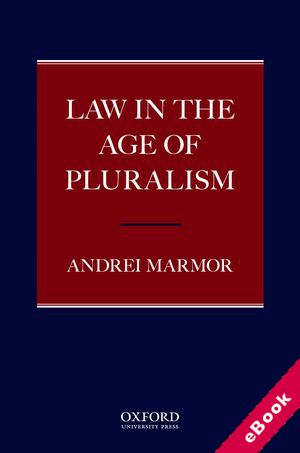
Law in the Age of Pluralism contains a collection of essays on the intersection of legal and political philosophy. Written within the analytical tradition in jurisprudence, the collection covers a wide range of topics, such as the nature of law and legal theory, the rule of law, the values of democracy and constitutionalism, moral aspects of legal interpretation, the nature of rights, economic equality, and more.
The essays in this volume explore issues where law, morality and politics meet, and discuss some of the key challenges facing liberal democracies. Marmor posits that a liberal state must first and foremost respect people's personal autonomy and their differing, though reasonable, conceptions of the good and the just. This basic respect for pluralism is shown to entail a rather skeptical attitude towards grand theories of law and state, such as contemporary constitutionalism or Dworkin's conception of 'law as integrity'. The values of pluralism and respect for autonomy, however, are also employed to justify some of the main aspects of a liberal state, such as the value of democracy, the rule of law, and certain conceptions of equality.The essays are organized in three groups: the first considers the rule of law, democracy and constitutionalism. The second group consists of several essays on the nature of law, legal theory, and their relations to morality. Finally, the collection concludes with essays on the nature of rights, the limits of rights discourse, and the value of economic equality.










