
The eBooks we sell are sold as a single-user licence and are intended for the end user only.
The sale of some eBooks are restricted to certain countries. To alert you to such restrictions, please select the country of the billing address of your credit or debit card you wish to use for payment.
For further information see https://www.wildy.com/ebook-formats
Once the order is confirmed an e-mail will be sent to you to allow you to download the eBook. For UK purchases this will be automatic. For purchases outside the UK a member of staff will need to confirm the sale. (Staff are available to do this during normal business hours, Mon-Fri 8:30-17:00 UK time)
All eBooks are supplied firm sale and cannot be returned. If you believe there is a fault with your eBook then contact us on ebooks@wildy.com and we will help in resolving the issue. This does not affect your statutory rights.
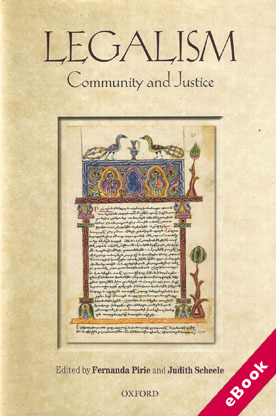
'Community' and 'justice' recur in anthropological, historical, and legal scholarship, yet as concepts they are notoriously slippery. Historians and lawyers look to anthropologists as 'community specialists', but anthropologists often avoid the concept through circumlocution: although much used (and abused) by historians, legal thinkers, and political philosophers, the term remains strikingly indeterminate and often morally overdetermined.
'Justice', meanwhile, is elusive, alternately invoked as the goal of contemporary political theorizing, and wrapped in obscure philosophical controversy. A conceptual knot emerges in much legal and political thought between law, justice, and community, but theories abound, without any agreement over concepts.
The contributors to this volume use empirical case studies to unpick threads of this knot. Local codes from Anglo-Saxon England, north Africa, and medieval Armenia indicate disjunctions between community boundaries and the subjects of local rules and categories; processes of justice from early modern Europe to eastern Tibet suggest new ways of conceptualizing the relationship between law and justice; and practices of exile that recur throughout the world illustrate contingent formulations of community.
In the first book in the series, Legalism: Anthropology and History, law was addressed through a focus on local legal categories as conceptual tools. Here this approach is extended to the ideas and ideals of justice and community. Rigorous cross-cultural comparison allows the contributors to avoid normative assumptions, while opening new avenues of inquiry for lawyers, anthropologists, and historians alike.










