
The eBooks we sell are sold as a single-user licence and are intended for the end user only.
The sale of some eBooks are restricted to certain countries. To alert you to such restrictions, please select the country of the billing address of your credit or debit card you wish to use for payment.
For further information see https://www.wildy.com/ebook-formats
Once the order is confirmed an e-mail will be sent to you to allow you to download the eBook. For UK purchases this will be automatic. For purchases outside the UK a member of staff will need to confirm the sale. (Staff are available to do this during normal business hours, Mon-Fri 8:30-17:00 UK time)
All eBooks are supplied firm sale and cannot be returned. If you believe there is a fault with your eBook then contact us on ebooks@wildy.com and we will help in resolving the issue. This does not affect your statutory rights.
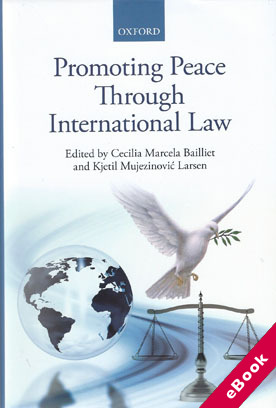
Within international law there is no unified concept of peace. This book addresses this gap by considering the liberal conception of peace within Western philosophy alongside the principle of 'peaceful coexistence' supported in the East. By tracing the evolution of the international law of peace through its historical and philosophical origins, this book investigates whether there is a 'right to peace'.
The book explores how existing international law and institutions contribute to the establishment of peace, or how they fail to do so. It sets out how international law promotes the negative dimension of peace-the absence of structural violence-as well as its positive dimension: the presence of underlying conditions for peace. It also investigates whether international actors and institutions have particular obligations in relation to the establishment and maintenance of peace.
Discussions include: the relationships between the different regimes of human rights, trade, development, the environment, and regulation of arms trade with peace; the role of women, refugees, and other groups seeking equal treatment; the role of peacekeepers, transitional justice mechanisms, international courts fact-finding missions, and national constitutional frameworks in upholding peace in practice; and how civil society participates in the promotion and safeguarding of peace. The book's comprehensive treatment of the concept of peace in international law makes it an ideal reference work for those working in the field, as well as for students.










