
The eBooks we sell are sold as a single-user licence and are intended for the end user only.
The sale of some eBooks are restricted to certain countries. To alert you to such restrictions, please select the country of the billing address of your credit or debit card you wish to use for payment.
For further information see https://www.wildy.com/ebook-formats
Once the order is confirmed an e-mail will be sent to you to allow you to download the eBook. For UK purchases this will be automatic. For purchases outside the UK a member of staff will need to confirm the sale. (Staff are available to do this during normal business hours, Mon-Fri 8:30-17:00 UK time)
All eBooks are supplied firm sale and cannot be returned. If you believe there is a fault with your eBook then contact us on ebooks@wildy.com and we will help in resolving the issue. This does not affect your statutory rights.
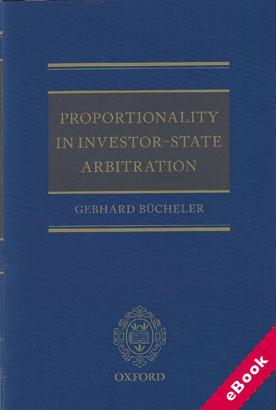
While international investment law is one of the most dynamic and thriving fields of international law, it is increasingly criticized for failing to strike a fair balance between private property rights and the public interest. Proportionality is a tool to resolve conflicts between competing rights and interests. This book assesses its current role, its potential, and its limits in investor-State arbitration. Proportionality is often lauded for reconciling colliding interests.
This book identifies three factors arbitrators should consider before engaging in a proportionality analysis: the rule of law, the risk of judicial law-making, and the availability of a value systems that guides the proportionality analysis. Apart from making suggestions when arbitrators should apply proportionality and when not to, the book outlines what States can do to recalibrate the balance between private property rights and the public interest if they wish to do so without dismantling the current system of investor-State arbitration.
Proportionality in Investor-State Arbitration considers whether and to what extent the notion of general principles of law within the meaning of Article 38(1)(c) of the ICJ Statute and the concept of systemic integration enshrined in Article 31(3)(c) of the Vienna Convention on the Law of Treaties provides a valid legal foundation for applying proportionality in investor-State arbitration.










