
The eBooks we sell are sold as a single-user licence and are intended for the end user only.
The sale of some eBooks are restricted to certain countries. To alert you to such restrictions, please select the country of the billing address of your credit or debit card you wish to use for payment.
For further information see https://www.wildy.com/ebook-formats
Once the order is confirmed an e-mail will be sent to you to allow you to download the eBook. For UK purchases this will be automatic. For purchases outside the UK a member of staff will need to confirm the sale. (Staff are available to do this during normal business hours, Mon-Fri 8:30-17:00 UK time)
All eBooks are supplied firm sale and cannot be returned. If you believe there is a fault with your eBook then contact us on ebooks@wildy.com and we will help in resolving the issue. This does not affect your statutory rights.
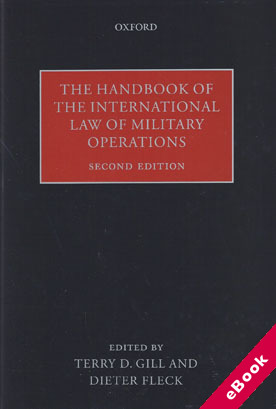
The second edition of this well received handbook provides a comprehensive overview and annotated commentary of those areas of international law most relevant to the planning and conduct of military operations.
It covers a wide scope of military operations, ranging from operations conducted under UN Security Council mandate to (collective) self-defence and consensual and humanitarian operations and identifies the relevant legal bases and applicable legal regimes governing the application of force and treatment of persons during such operations. It also devotes attention to the law governing the status of forces, military use of the sea and airspace and questions of international (criminal) responsibility for breaches of international law.
New developments such as cyber warfare and controversial aspects of law in relation to contemporary operations, such as targeted killing of specific individuals are discussed and analysed, alongside recent developments in more traditional types of operations, such as peacekeeping and naval operations.
The book is aimed at policy officials, commanders and their (military) legal advisors who are involved with the planning and conduct of any type of military operation and is intended to complement national and international policy and legal guidelines and assist in identifying and applying the law to ensure legitimacy and contribute to mission accomplishment.
It likewise fulfils a need in pertinent international organizations, such as the UN, NATO, Regional Organizations, and NGOs. It also serves as a comprehensive work of reference to academics and is suitable for courses at military staff colleges, academies and universities, which devote attention to one or more aspects of international law treated in the book.
This mix of intended users is reflected in the contributors who include senior (former) policy officials and (military) legal advisors, alongside academics engaged in teaching and research in these areas of international law.










