
The eBooks we sell are sold as a single-user licence and are intended for the end user only.
The sale of some eBooks are restricted to certain countries. To alert you to such restrictions, please select the country of the billing address of your credit or debit card you wish to use for payment.
For further information see https://www.wildy.com/ebook-formats
Once the order is confirmed an e-mail will be sent to you to allow you to download the eBook. For UK purchases this will be automatic. For purchases outside the UK a member of staff will need to confirm the sale. (Staff are available to do this during normal business hours, Mon-Fri 8:30-17:00 UK time)
All eBooks are supplied firm sale and cannot be returned. If you believe there is a fault with your eBook then contact us on ebooks@wildy.com and we will help in resolving the issue. This does not affect your statutory rights.
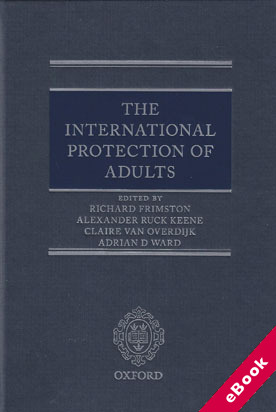
Increasing numbers of people have connections with one country, but live and work in another, frequently owning property or investments in several countries. People with lifelong or subsequently developed impairments of capacity move cross-border or have property or family interests or connections spread across different jurisdictions.
This new work fills a gap in a specialist market for a detailed work advising lawyers on all the considerations in these situations. The book provides a clear, comprehensive, and unique overview of all relevant capacity and private international law issues, and the existing solutions in common law and civil law jurisdictions and under Hague Convention XXXV.
It sets out the existing law of various important jurisdictions, including detailed chapters on the constituent parts of the UK, Ireland, Jersey, the Isle of Man and the Hague 35 states; and shorter chapters on 26 Non-Hague states and those within federal states, including coverage of the United States, several Australian and Canadian states, and a number of other Commonwealth jurisdictions.
Containing a number of helpful case studies and flowcharts, the book draws upon the expertise of the editors in their respective fields, together with detailed contributions from expert practitioners and academics from each relevant jurisdiction. All the editors and many of the contributors and correspondents are members of STEP.










