The eBooks we sell are sold as a single-user licence and are intended for the end user only.
The sale of some eBooks are restricted to certain countries. To alert you to such restrictions, please select the country of the billing address of your credit or debit card you wish to use for payment.
For further information see https://www.wildy.com/ebook-formats
Once the order is confirmed an e-mail will be sent to you to allow you to download the eBook. For UK purchases this will be automatic. For purchases outside the UK a member of staff will need to confirm the sale. (Staff are available to do this during normal business hours, Mon-Fri 8:30-17:00 UK time)
All eBooks are supplied firm sale and cannot be returned. If you believe there is a fault with your eBook then contact us on ebooks@wildy.com and we will help in resolving the issue. This does not affect your statutory rights.
Due to a technical issue some ebooks are not available to order.
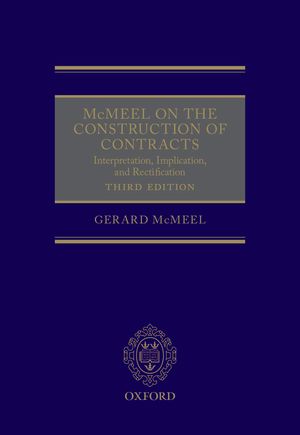
Now in its third edition, this authoritative work on the construction of contracts is an invaluable resource for legal practitioners and academics seeking to understand the legal principles involved in contract interpretation as well as the current trends in the neighbouring topics of implied terms and rectification.
The third edition continues its principle-by-principle coverage of the main elements of contractual construction with reference to recent case law. Recent major construction of contract cases are discussed, including the UK Supreme Court decisions of Rainy Sky v Kookmin Bank (2011), Arnold v Britton (2015), the Lloyds Bank Bonds case (2016), and Wood v Capita Insurance Services (2017). Guidance is provided on balancing text, context, common sense and commercial purpose. The discussion of the implication of terms reflects the sceptical treatment of Belize Telecom (2009) in the Marks & Spencer case (2015). The issue of rectification addressed in detail in the new edition, reflecting the law's state of flux in this area with cases such as Daventry (2011), Cherry Tree v Landmain (2012) and Tartsinis v Navona (2015). The role of good faith is discussed with reference to Leggatt J in Yam Seng (2014) and the Court of Appeal in MSC Mediterranean Shipping v Cottonex (2016). Agreed damages clauses are revisited in the light of the reining in of the penalty rule in Cavendish v Makdessi (2016). There is consideration of Prime Sight v Lavarello (2013) and the Privy Council's reflections on contractual estoppel.
Providing practical guidance on how courts would interpret contractual terms with reference to recent commercial contract litigation, this is the essential reference work for all commercial and corporate lawyers, both litigators and those negotiating and drafting deals.