
The eBooks we sell are sold as a single-user licence and are intended for the end user only.
The sale of some eBooks are restricted to certain countries. To alert you to such restrictions, please select the country of the billing address of your credit or debit card you wish to use for payment.
For further information see https://www.wildy.com/ebook-formats
Once the order is confirmed an e-mail will be sent to you to allow you to download the eBook. For UK purchases this will be automatic. For purchases outside the UK a member of staff will need to confirm the sale. (Staff are available to do this during normal business hours, Mon-Fri 8:30-17:00 UK time)
All eBooks are supplied firm sale and cannot be returned. If you believe there is a fault with your eBook then contact us on ebooks@wildy.com and we will help in resolving the issue. This does not affect your statutory rights.
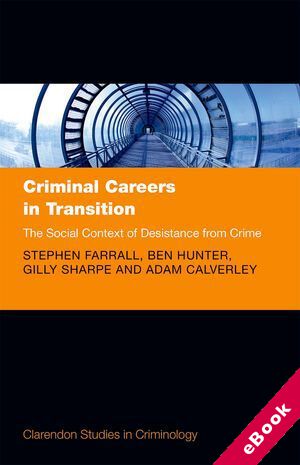
Continuing previous work exploring why people stop offending, and the processes by which they are rehabilitated in the community, Criminal Careers in Transition: The Social Context of Desistance from Crime follows the completion of a fifth sweep of interviews with members of a cohort of former probationers interviewed since the late-1990s. The research undertaken since the inception of the project in 1996 has focused on developing a long-term evidence base, rather than a rapid assessment, examining whether (and how) probation supervision assists desistance from crime. Building on interviews from previous sweeps, the authors continue their exploration into the needs identified by probation officers and probationers, the extent to which these have been successfully met over the medium to long-term, and whether this suggests that probation helps probationers to desist. The authors argue that probation supervision did indeed help the probationers, but that this had taken a long time to 'bear fruit' and was related to other social and personal changes. There is discussion of a number of key topics, including sample members' continued social and personal development (including the impact of parenthood on them) and their motivation to change and maintain a law-abiding lifestyle, as well as their experiences of dealing with the stigma of a criminal record and the long-term process of 'remaking' themselves. This core empirical research and analysis is framed by a comprehensive review of not only the contemporary literature on desistance and reoffending, but also what constitutes a successful and effective research design in this field. Whilst there have been several attempts to develop theories of desistance, few have attempted to understand and theorise the long-term impacts of probation supervision. Criminal Careers in Transition addresses this by building an account of the processes which help to shape the speed, nature, and direction of an individual's efforts to avoid further offending and, thus, develop a theory of assisted desistance. The book continues the authors' exploration of the emotional trajectories of crime, victimisation, and desistance and the role of citizenship values in pathways out of crime, as well as original research into the spatial dynamics of desistance.










