
The eBooks we sell are sold as a single-user licence and are intended for the end user only.
The sale of some eBooks are restricted to certain countries. To alert you to such restrictions, please select the country of the billing address of your credit or debit card you wish to use for payment.
For further information see https://www.wildy.com/ebook-formats
Once the order is confirmed an e-mail will be sent to you to allow you to download the eBook. For UK purchases this will be automatic. For purchases outside the UK a member of staff will need to confirm the sale. (Staff are available to do this during normal business hours, Mon-Fri 8:30-17:00 UK time)
All eBooks are supplied firm sale and cannot be returned. If you believe there is a fault with your eBook then contact us on ebooks@wildy.com and we will help in resolving the issue. This does not affect your statutory rights.
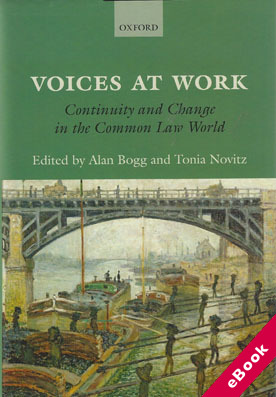
This edited collection is the culmination of a comparative project on 'Voices at Work' funded by the Leverhulme Trust 2010 - 2013. The book aims to shed light on the problematic concept of worker 'voice' by tracking its evolution and its complex interactions with various forms of law.
Contributors to the volume identify the scope for continuity of legal approaches to voice and the potential for change in a sample of industrialised English speaking common law countries, namely Australia, Canada, New Zealand, UK, and USA.
These countries, facing broadly similar regulatory dilemmas, have often sought to borrow and adapt certain legal mechanisms from one another. The variance in the outcomes of any attempts at 'borrowing' seems to demonstrate that, despite apparent membership of a 'common law' family, there are significant differences between industrial systems and constitutional traditions, thereby casting doubt on the notion that there are definitive legal solutions which can be applied through transplantation. Instead, it seems worth studying the diverse possibilities for worker voice offered in divergent contexts, not only through traditional forms of labour law, but also such disciplines as competition law, human rights law, international law and public law. In this way, the comparative study highlights a rich multiplicity of institutions and locations of worker voice, configured in a variety of ways across the English-speaking common law world.
This book comprises contributions from many leading scholars of labour law, politics and industrial relations drawn from across the jurisdictions, and is therefore an exceedingly comprehensive comparative study. It is addressed to academics, policymakers, legal practitioners, legislative drafters, trade unions and interest groups alike.
Additionally, while offering a critique of existing laws, this book proposes alternative legal tools to promote engagement with a multitude of 'voices' at work and therefore foster the effective deployment of law in industrial relations.










