
The eBooks we sell are sold as a single-user licence and are intended for the end user only.
The sale of some eBooks are restricted to certain countries. To alert you to such restrictions, please select the country of the billing address of your credit or debit card you wish to use for payment.
For further information see https://www.wildy.com/ebook-formats
Once the order is confirmed an e-mail will be sent to you to allow you to download the eBook. For UK purchases this will be automatic. For purchases outside the UK a member of staff will need to confirm the sale. (Staff are available to do this during normal business hours, Mon-Fri 8:30-17:00 UK time)
All eBooks are supplied firm sale and cannot be returned. If you believe there is a fault with your eBook then contact us on ebooks@wildy.com and we will help in resolving the issue. This does not affect your statutory rights.
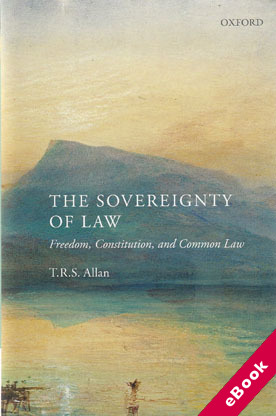
In The Sovereignty of Law Trevor Allan presents an accessible introduction to his influential common law constitutional theory - an account of the unwritten constitution as a complex articulation of legal and moral principles.
The British constitution is conceived as a coherent set of fundamental principles of the rule of law, legislative supremacy, and separation of powers. These principles combine to provide an overarching unity of legality, legitimacy, and democracy, reconciling political authority with individual freedom.
Drawing on the work of Lon Fuller and Ronald Dworkin, Allan emphasizes the normative character of legal interpretation - understanding the implications of statute and precedent by reference to moral ideals of legality and liberty. Allan denies that constitutional law can be reduced to empirical facts about legislative or judicial conduct or opinion. There is no 'rule of recognition' from the lawyer's interpretative viewpoint - only a moral theory of the nature and limits of political authority, which lawyers must construct in order to make sense of legal and constitutional practice.
A genuine republicanism, protecting individual independence, requires the safeguards afforded by judicial review, which must ensure that governmental action is consistent with the rule of law; and the rule of law encompasses not merely the formal equality of all before the law, as enacted or declared, but a more fundamental idea of equal citizenship.
Allan's interpretative approach is applied to a wide range of contemporary issues of public law; his response to critics and commentators seeks to deepen the argument by exploring the theoretical grounds of these current debates and controversies.










