
The eBooks we sell are sold as a single-user licence and are intended for the end user only.
The sale of some eBooks are restricted to certain countries. To alert you to such restrictions, please select the country of the billing address of your credit or debit card you wish to use for payment.
For further information see https://www.wildy.com/ebook-formats
Once the order is confirmed an e-mail will be sent to you to allow you to download the eBook. For UK purchases this will be automatic. For purchases outside the UK a member of staff will need to confirm the sale. (Staff are available to do this during normal business hours, Mon-Fri 8:30-17:00 UK time)
All eBooks are supplied firm sale and cannot be returned. If you believe there is a fault with your eBook then contact us on ebooks@wildy.com and we will help in resolving the issue. This does not affect your statutory rights.
Due to a technical issue some ebooks are not available to order.
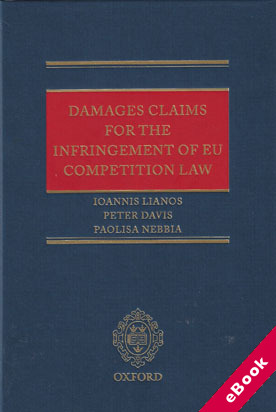
Damages Claims for the Infringement of Competition Law addresses the current state of the law in the EU on damages claims for the infringement of EU competition law by combining a theoretical with a practical perspective. The work first focuses on the relevant EU acquis, examining all aspects of EU law that may be relevant to damages claims (whether brought by a consumer or not) such as those concerning fault, alternative dispute resolution, as well as private international law instruments.
The book then delves into the economic underpinnings of claims for damages, including optimal enforcement theory and damages and the legal standards of liability, the evaluation of damages for cartels, exploitative conduct and exclusionary conduct. The work also examines collective actions (legal regime and financing aspects), the interaction between damages claims and public enforcement, causation as well as issues relating to multi-jurisdictional enforcement and damages claims.
The book provides a discussion of the emerging field of competion law damages and explores the important questions it raises about the use of the traditional tort law catergories in an area of law that is heavily infused with economic analysis. It combines a corrective justice perspective with an empirical and theoretical analysis of the practice of competiton law damages in various jurisdictions in Europe. Rather than adopting the traditional economic analysis law of approach, the authors respect the autonomy of the fields of law and economics, while attempting to identify the areas of conflict that may emerge when economic concepts and categories are integrated in the legal system.










