
The eBooks we sell are sold as a single-user licence and are intended for the end user only.
The sale of some eBooks are restricted to certain countries. To alert you to such restrictions, please select the country of the billing address of your credit or debit card you wish to use for payment.
For further information see https://www.wildy.com/ebook-formats
Once the order is confirmed an e-mail will be sent to you to allow you to download the eBook. For UK purchases this will be automatic. For purchases outside the UK a member of staff will need to confirm the sale. (Staff are available to do this during normal business hours, Mon-Fri 8:30-17:00 UK time)
All eBooks are supplied firm sale and cannot be returned. If you believe there is a fault with your eBook then contact us on ebooks@wildy.com and we will help in resolving the issue. This does not affect your statutory rights.
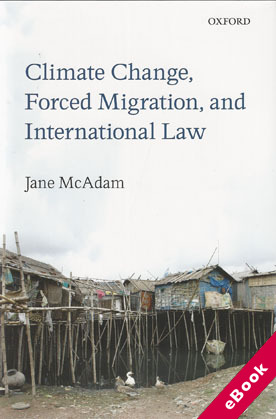
Displacement caused by climate change is an area of growing concern. With current rises in sea levels and changes to the global climate, it is an issue of fundamental importance to the future of many parts of the world.
This book critically examines whether States have obligations to protect people displaced by climate change under international refugee law, international human rights law, and the international law on statelessness. Drawing on field work undertaken in Bangladesh, India, and the Pacific island States of Kiribati and Tuvalu, it evaluates whether the phenomenon of 'climate change-induced displacement' is an empirically sound category for academic inquiry.
It does so by examining the reasons why people move (or choose not to move); the extent to which climate change, as opposed to underlying socio-economic factors, provides a trigger for such movement; and whether traditional international responses, such as the conclusion of new treaties and the creation of new institutions, are appropriate solutions in this context.
In this way, the book queries whether flight from habitat destruction should be viewed as another facet of traditional international protection or as a new challenge requiring more creative legal and policy responses.










