
The eBooks we sell are sold as a single-user licence and are intended for the end user only.
The sale of some eBooks are restricted to certain countries. To alert you to such restrictions, please select the country of the billing address of your credit or debit card you wish to use for payment.
For further information see https://www.wildy.com/ebook-formats
Once the order is confirmed an e-mail will be sent to you to allow you to download the eBook. For UK purchases this will be automatic. For purchases outside the UK a member of staff will need to confirm the sale. (Staff are available to do this during normal business hours, Mon-Fri 8:30-17:00 UK time)
All eBooks are supplied firm sale and cannot be returned. If you believe there is a fault with your eBook then contact us on ebooks@wildy.com and we will help in resolving the issue. This does not affect your statutory rights.
Wildy's Book of the Month: February 2014
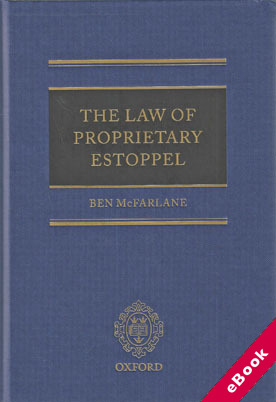
This book provides the first comprehensive and practically structured resource on the doctrine of proprietary estoppel. It offers answers to a number of difficult problems arising in recent litigation and guidance on managing proprietary estoppel cases.
Relevant authorities are set out in an accessible and user-friendly format addressing issues that arise in practice, such as 'reasonable reliance', 'unconscionable conduct', and 'satisfying the equity'.
The long-standing doctrine of proprietary estoppel has come to prominence in recent years - it is regularly discussed by courts at all levels and is frequently pleaded by litigants wishing to show that they have informally acquired an interest in land.
As a result of its vigorous recent development by the courts, there is no comprehensive and uncontroversial definition of the doctrine. There is also much debate regarding the relationship between proprietary estoppel and other doctrines, such as constructive trusts and unjust enrichment. A problem faced by anyone seeking to make, or respond to, a proprietary estoppel claim is that the law is to be found almost entirely in cases.
The Law of Proprietary Estoppel sets out a clear structure with which to understand the law and will thus assist practitioners, academics, and others in navigating their way through the complex case law on proprietary estoppel, and also in understanding its relationship with related doctrines.
This book is essential for all practitioners and scholars who encounter problems related to the doctrine of proprietary estoppel. The clear structure of the book makes the law easier to follow and enables readers to find relevant authorities quickly. The work draws together all of the relevant scholarship on proprietary estoppel and makes reference to useful cases from outside the jurisdiction of England and Wales to aid understanding of the law and related doctrines.










