The eBooks we sell are sold as a single-user licence and are intended for the end user only.
The sale of some eBooks are restricted to certain countries. To alert you to such restrictions, please select the country of the billing address of your credit or debit card you wish to use for payment.
For further information see https://www.wildy.com/ebook-formats
Once the order is confirmed an e-mail will be sent to you to allow you to download the eBook. For UK purchases this will be automatic. For purchases outside the UK a member of staff will need to confirm the sale. (Staff are available to do this during normal business hours, Mon-Fri 8:30-17:00 UK time)
All eBooks are supplied firm sale and cannot be returned. If you believe there is a fault with your eBook then contact us on ebooks@wildy.com and we will help in resolving the issue. This does not affect your statutory rights.
Due to a technical issue some ebooks are not available to order.
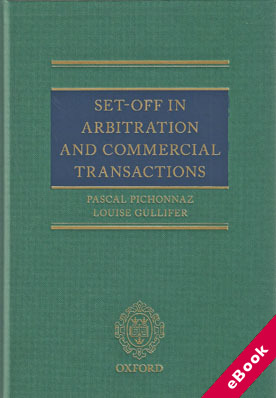
This book considers the issues involved in international commercial disputes where set-off has been used. Most such disputes are conducted through arbitration so the focus of this book is on the effect of arbitration proceedings on set-off claims.
The book considers the important institutional rules of arbitration procedure such as the Swiss Rules, the CNUDCI, the ICC rules and others. It covers in some detail the various possible solutions to the issue of applicable law under national and supra-national law. Included in this discussion is an analysis of the Rome I Regulation, the CISG, and the UNIDROIT Principles contained in the PICC and PECL. There is full consideration of the other relevant matters including enforceability, currency issues, and burden of proof.
The last section of the book analyses the position of set off in insolvency, including a general comparative look at the situation in common and civil law, and concluding with an explanation of the effect of the European Regulation on Insolvency Proceedings. Set-off is a commonly used but complex device used to avoid the cumbersome transfer of money in international commercial transactions.
The situation is made even more complex when disputes arise bringing issues of applicable law and jurisdiction. This book raises the potential issues and analyses the probable solutions with reference to national and international laws and arbitral rules. It will assist common law practitioners with practical solutions under major civil law jurisdictions and vice versa.