
The eBooks we sell are sold as a single-user licence and are intended for the end user only.
The sale of some eBooks are restricted to certain countries. To alert you to such restrictions, please select the country of the billing address of your credit or debit card you wish to use for payment.
For further information see https://www.wildy.com/ebook-formats
Once the order is confirmed an e-mail will be sent to you to allow you to download the eBook. For UK purchases this will be automatic. For purchases outside the UK a member of staff will need to confirm the sale. (Staff are available to do this during normal business hours, Mon-Fri 8:30-17:00 UK time)
All eBooks are supplied firm sale and cannot be returned. If you believe there is a fault with your eBook then contact us on ebooks@wildy.com and we will help in resolving the issue. This does not affect your statutory rights.
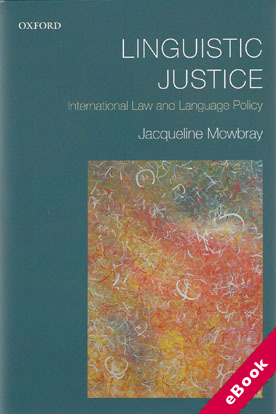
Globalisation and migration are producing societies of increasing linguistic diversity. At the same time, English is achieving unprecedented global dominance, smaller languages are becoming 'extinct' at an alarming rate, and ethnic tensions in countries from Belgium to Tibet continue to centre on questions of language.
Against this background, the issue of how to ensure justice between speakers of different languages becomes a pressing social concern. Matters of 'linguistic justice' are therefore drawing increasing scholarly attention across a range of disciplines. How does international law contribute to linguistic justice?
This book explores that question by conducting a comprehensive, interdisciplinary examination of international law on language, analysing the many disparate fields of international law which affect language use both directly (human rights, cultural heritage laws, and EU legislation, for example) and indirectly (international trade law and international labour standards, among others).
Moving beyond the technical analysis of legal provisions, the book explores the conceptual framework which underpins international law on language, unearthing underlying assumptions, and ideas about what constitutes a 'just' language policy from a legal perspective. In doing so, the book draws on the methodology of sociologist Pierre Bourdieu, whose ideas of 'habitus' and 'field' offer a way of understanding the changing significance of language to human identity, and the way in which language becomes a focal point for the exercise of social power.
This analysis reveals the limitations of contemporary international law on language, and charts a course towards the achievement of greater 'linguistic justice'.










