
The eBooks we sell are sold as a single-user licence and are intended for the end user only.
The sale of some eBooks are restricted to certain countries. To alert you to such restrictions, please select the country of the billing address of your credit or debit card you wish to use for payment.
For further information see https://www.wildy.com/ebook-formats
Once the order is confirmed an e-mail will be sent to you to allow you to download the eBook. For UK purchases this will be automatic. For purchases outside the UK a member of staff will need to confirm the sale. (Staff are available to do this during normal business hours, Mon-Fri 8:30-17:00 UK time)
All eBooks are supplied firm sale and cannot be returned. If you believe there is a fault with your eBook then contact us on ebooks@wildy.com and we will help in resolving the issue. This does not affect your statutory rights.
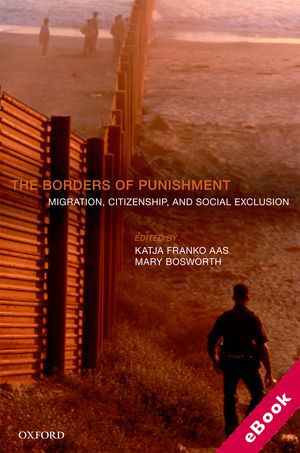
The Borders of Punishment: Migration, Citizenship, and Social Exclusion critically assesses the relationship between immigration control, citizenship, and criminal justice. It reflects on the theoretical and methodological challenges posed by mass mobility and its control and for the first time, sets out a particular sub-field within criminology, the criminology of mobility.
Drawing together leading international scholars with newer researchers, the book systematically outlines why criminology and criminal justice should pay more attention to issues of immigration and border control.
Contributors consider how 'traditional' criminal justice institutions such as the criminal law, police, and prisons are being shaped and altered by immigration, as well as examining novel forms of penality (such as deportation and detention facilities), which have until now seldom featured in criminological studies and textbooks. In so doing, the book demonstrates that mobility and its control are matters that ought to be central to any understanding of the criminal justice system.
Phenomena such as the controversial use of immigration law for the purposes of the war on terror, closed detention centres, deportation, and border policing, raise in new ways some of the fundamental and enduring questions of criminal justice and criminology: What is punishment? What is crime? What should be the normative and legal foundation for criminalization, for police suspicion, for the exclusion from the community, and for the deprivation of freedom? And who is the subject of rights within a society and what is the relevance of citizenship to criminal justice?










