
The eBooks we sell are sold as a single-user licence and are intended for the end user only.
The sale of some eBooks are restricted to certain countries. To alert you to such restrictions, please select the country of the billing address of your credit or debit card you wish to use for payment.
For further information see https://www.wildy.com/ebook-formats
Once the order is confirmed an e-mail will be sent to you to allow you to download the eBook. For UK purchases this will be automatic. For purchases outside the UK a member of staff will need to confirm the sale. (Staff are available to do this during normal business hours, Mon-Fri 8:30-17:00 UK time)
All eBooks are supplied firm sale and cannot be returned. If you believe there is a fault with your eBook then contact us on ebooks@wildy.com and we will help in resolving the issue. This does not affect your statutory rights.
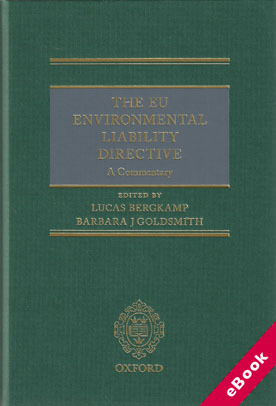
The European Union's Environmental Liability Directive (ELD) first published in 2004 and has since been transposed into the national laws of all EU Member States. However there is little guidance available to authorities and industry in interpreting and applying the ELD and meeting its prevention and restoration objectives.
This volume is the first to describe the EU's ELD and to examine the emerging issues and practices in its application. The ELD imposes liability for significant damage to natural habitats and species protected at Community and national levels, surface and ground waters covered by the Water Framework Directive, and land. Prior to the ELD's adoption many Member States had programs in place for the restoration of soil and groundwater contamination, but none had a regime for addressing harm to unowned natural resources.
This volume presents a comprehensive legal commentary on the legal issues arising under the ELD, as well as an overview of administrative, technical, and legal issues and practices in applying the ELD regimes to cases of actual or threatened environmental damage. In doing so, it discusses both substantive issues and important procedural and process-related issues.
Several case studies are presented to illustrate the issues and practical solutions. In addition, emerging best practices relating to practical ELD application are identified and presented. Identifying and discussing a wide range of emerging administrative, technical, and economic practice issues arising under member state legislation transposing and implementing the ELD, this book will be a valuable resource for all those whose work is affected by the ELD.










