The eBooks we sell are sold as a single-user licence and are intended for the end user only.
The sale of some eBooks are restricted to certain countries. To alert you to such restrictions, please select the country of the billing address of your credit or debit card you wish to use for payment.
For further information see https://www.wildy.com/ebook-formats
Once the order is confirmed an e-mail will be sent to you to allow you to download the eBook. For UK purchases this will be automatic. For purchases outside the UK a member of staff will need to confirm the sale. (Staff are available to do this during normal business hours, Mon-Fri 8:30-17:00 UK time)
All eBooks are supplied firm sale and cannot be returned. If you believe there is a fault with your eBook then contact us on ebooks@wildy.com and we will help in resolving the issue. This does not affect your statutory rights.
Due to a technical issue some ebooks are not available to order.
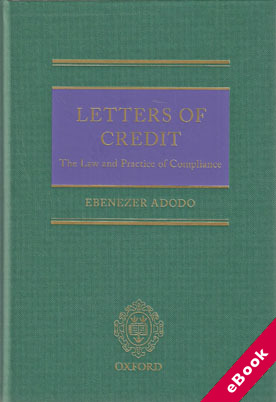
This book examines the legal nature and requirements of compliance in letter of credit transactions in Anglo-American jurisdictions, as well as the associated contract choice of law issues.
It gives an authoritative exposition of the mechanics of the law on the problem of compliance in the field, and is the first to afford a comprehensive, highly analytical critique of the topic from the point of view of modern international banking practice. In a user-friendly style, it provides an in-depth elucidation of the context of the key roles of individual parties during the course of the transactions, aiding a thorough understanding of the legal problems covered.
Structured in four parts, it covers the opening of a complying letter of credit; the regularity of performance under a properly opened letter of credit; ways in which an unreimbursed bank may recover money it mistakenly paid against a faulty presentation; and the conflict of laws problems involved in the context of a beneficiary claiming entitlement to the sum on the credit against an allegedly complying tender of documents.
In the conflict of laws section substantial attention is given to the many difficult hurdles that the potential claimant often confronts, and explores the various methods and techniques available. An important aspect of the analysis in this part is ascertainment of the legal system which the courts at common law and under Rome I Regulation would apply to resolve a claim.