
The eBooks we sell are sold as a single-user licence and are intended for the end user only.
The sale of some eBooks are restricted to certain countries. To alert you to such restrictions, please select the country of the billing address of your credit or debit card you wish to use for payment.
For further information see https://www.wildy.com/ebook-formats
Once the order is confirmed an e-mail will be sent to you to allow you to download the eBook. For UK purchases this will be automatic. For purchases outside the UK a member of staff will need to confirm the sale. (Staff are available to do this during normal business hours, Mon-Fri 8:30-17:00 UK time)
All eBooks are supplied firm sale and cannot be returned. If you believe there is a fault with your eBook then contact us on ebooks@wildy.com and we will help in resolving the issue. This does not affect your statutory rights.
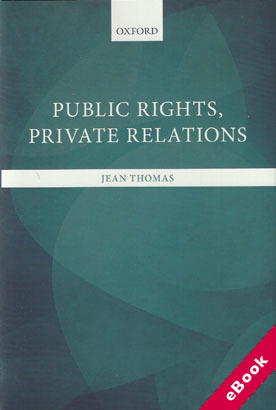
The abuse of workers in export processing zones in developing countries, the undignified treatment of elderly people in care homes, and the dangers for internet users' privacy arising from private companies' control of their data are prominent examples of how our most fundamental interests are increasingly jeopardized by powerful private actors.
Jean Thomas argues that, while these interests are protected by human and constitutional rights in relation to the state, no similar protections exist in relations among private actors. To address this problem, she develops a theoretical framework for the application of human and constitutional rights among private actors.
The author proposes a theory of private liability for public rights violations that allows us to answer the question: who should bear the duties associated with human and constitutional rights in the private sphere? And what do private actors owe one another in respect of the interests protected by these rights?
In advancing a model of rights that makes the application of public rights among private actors morally plausible and institutionally feasible, the book also illuminates the broader conceptual question of what rights are.










