
The eBooks we sell are sold as a single-user licence and are intended for the end user only.
The sale of some eBooks are restricted to certain countries. To alert you to such restrictions, please select the country of the billing address of your credit or debit card you wish to use for payment.
For further information see https://www.wildy.com/ebook-formats
Once the order is confirmed an e-mail will be sent to you to allow you to download the eBook. For UK purchases this will be automatic. For purchases outside the UK a member of staff will need to confirm the sale. (Staff are available to do this during normal business hours, Mon-Fri 8:30-17:00 UK time)
All eBooks are supplied firm sale and cannot be returned. If you believe there is a fault with your eBook then contact us on ebooks@wildy.com and we will help in resolving the issue. This does not affect your statutory rights.
Due to a technical issue some ebooks are not available to order.
Wildy's Book of the Month: February 2018
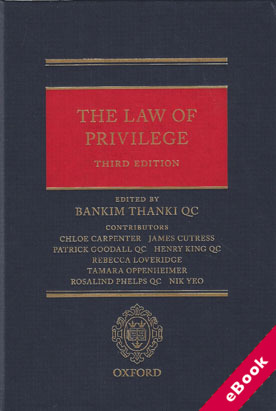
A sound understanding of legal professional privilege provides practitioners with a strategic advantage not to be underestimated.
This authoritative text provides a comprehensive reference to legal privilege in both contentious and non-contentious contexts. This book addresses both legal advice and litigation privilege, as well as privilege against self-incrimination. With broad coverage of how it arises, how it is lost, and its limits, the book begins with an outline of the law and policy underlying privilege before going on to provide expert guidance on issues that arise regularly in practice.
These issues include exceptions (including a detailed analysis of the crime/fraud exception), multi-jurisdictional issues, procedural matters, and problem areas such as pre-existing and partly privileged documents. It also covers: loss of legal professional privilege, for example the loss of confidence, and implied and express waiver; the linked area of being without prejudice privilege, its scope, exceptions, rules governing waiver, and the position in respect of mediation; and joint and common interest privilege.
Now in its third edition, the book has been comprehensively updated to cover all recent developments in privilege law. It considers the wealth of case law that has been published since the second edition, as well as placing much greater attention on privilege as it applies to investigations by regulatory and law enforcement agencies.
Written by a leading team from Fountain Court chambers including Bankim Thanki QC, who appeared in the Three Rivers litigation, The Law of Privilege is unrivalled in its clarity and supplies extensive cross-referencing and useful summaries throughout to ensure quick access to information.
It is an essential reference tool for practitioners in all fields of practice, as well as for students of Civil and Criminal Procedure, providing a concise route through what can be a challenging area of the law.










