
The eBooks we sell are sold as a single-user licence and are intended for the end user only.
The sale of some eBooks are restricted to certain countries. To alert you to such restrictions, please select the country of the billing address of your credit or debit card you wish to use for payment.
For further information see https://www.wildy.com/ebook-formats
Once the order is confirmed an e-mail will be sent to you to allow you to download the eBook. For UK purchases this will be automatic. For purchases outside the UK a member of staff will need to confirm the sale. (Staff are available to do this during normal business hours, Mon-Fri 8:30-17:00 UK time)
All eBooks are supplied firm sale and cannot be returned. If you believe there is a fault with your eBook then contact us on ebooks@wildy.com and we will help in resolving the issue. This does not affect your statutory rights.
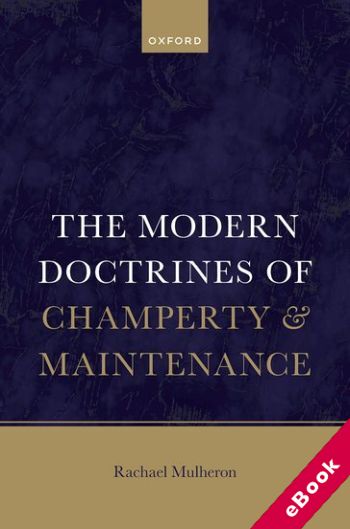
As torts and as crimes, champerty and maintenance were abolished by statute in England and Wales in 1967. They were considered to be obsolete and the product of a bygone age, when abuses of the court system as practised by rich and powerful noblemen required a robust legal response. A modern, sophisticated, and independent judiciary rendered it unnecessary either to punish or to compensate for champerty or maintenance any longer. However, post-1967, their impact was retained via a 'reservation provision', which ensures that any contract tainted by champerty or maintenance 'is to be treated as contrary to public policy or otherwise illegal.' Fast forward five decades to the present day, and whilst maintenance has arguably reached its use-by date in English law, the same cannot be said of its more aggressive cousin. Champerty, as a doctrine, retains considerable modern impact in this jurisdiction, stalking the modern funding and civil procedure landscape. It continues to have greatest impact in two areas: the funding of litigation, and the assignments of causes of action.
The Modern Doctrines of Champerty and Maintenance looks comparatively at jurisdictions' attitudes towards champerty and maintenance, together with an analysis of law reform studies in the area, both in England and elsewhere.










