
The eBooks we sell are sold as a single-user licence and are intended for the end user only.
The sale of some eBooks are restricted to certain countries. To alert you to such restrictions, please select the country of the billing address of your credit or debit card you wish to use for payment.
For further information see https://www.wildy.com/ebook-formats
Once the order is confirmed an e-mail will be sent to you to allow you to download the eBook. For UK purchases this will be automatic. For purchases outside the UK a member of staff will need to confirm the sale. (Staff are available to do this during normal business hours, Mon-Fri 8:30-17:00 UK time)
All eBooks are supplied firm sale and cannot be returned. If you believe there is a fault with your eBook then contact us on ebooks@wildy.com and we will help in resolving the issue. This does not affect your statutory rights.
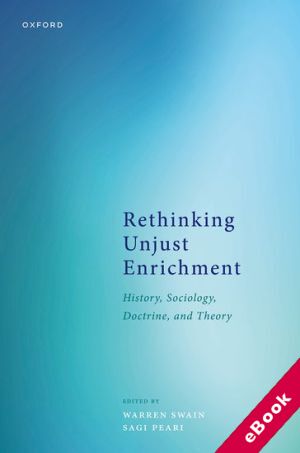
This inter-disciplinary volume brings together scholars from across the globe to challenge the dominant position of unjust enrichment and suggest more satisfactory alternatives.
Rethinking Unjust Enrichment includes a broad range of voices from the UK, US, Australia, Canada, China, Singapore, Germany, Ireland, New Zealand, Hong Kong, and South America. The book includes voices of sceptics who think that the current unjust enrichment doctrine must be seriously qualified and others who think that it should be eliminated altogether.
The contributions cast doubt on the various parameters of unjust enrichment from an analytical standpoint, representing four interrelated perspectives: history, sociology, doctrine, and theory. The four-limb structure of the book provides readers with a clear understanding of the current problems of unjust enrichment at the deepest levels of its history, sociological forces, doctrinal fallacies, and normative deficiencies. This treatment of the subject serves as the basis for a comprehensive reform across jurisdictions.
Comprehensive and multi-faceted, Rethinking Unjust Enrichment is interesting to both sceptics and supporters of the unjust enrichment. It facilitates a critical and constructive dialogue between the two.










