
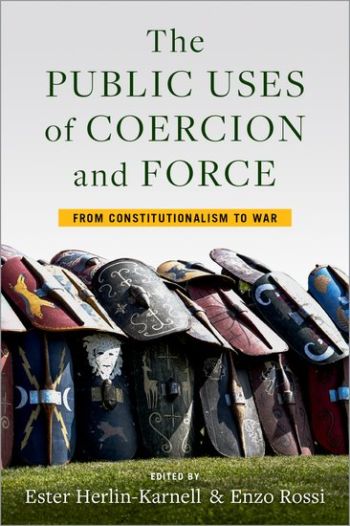
The Kantian project of achieving perpetual peace among states seems (at best) an unfulfilled hope. Modern states' authority claims and their exercise of power and sovereignty span a spectrum: from the most stringently and explicitly codified-the constitutional level-to the most fluid and turbulent-acts of war. The Public Uses of Coercion and Force investigates both these individual extremes and also their relationship. Using Arthur Ripstein's recent work Kant and the Law of War as a focal point, this book explores this connection through the lens of the (just) war theory and its relationship to the law.
The Public Uses of Coercion and Force asks many key questions: what, if any, are the normatively salient differences between states' internal coercion and the external use of force? Is it possible to isolate the constitutional level from other aspects of the state's coercive reach? How could that be done while also guaranteeing a robust conception of human rights and adherence to the rule of law? With individual replies by Ripstein to chapters, this book will be of interest to students and academics of constitutional law, justice, philosophy of law, criminal law theory, and political science.










