
The eBooks we sell are sold as a single-user licence and are intended for the end user only.
The sale of some eBooks are restricted to certain countries. To alert you to such restrictions, please select the country of the billing address of your credit or debit card you wish to use for payment.
For further information see https://www.wildy.com/ebook-formats
Once the order is confirmed an e-mail will be sent to you to allow you to download the eBook. For UK purchases this will be automatic. For purchases outside the UK a member of staff will need to confirm the sale. (Staff are available to do this during normal business hours, Mon-Fri 8:30-17:00 UK time)
All eBooks are supplied firm sale and cannot be returned. If you believe there is a fault with your eBook then contact us on ebooks@wildy.com and we will help in resolving the issue. This does not affect your statutory rights.
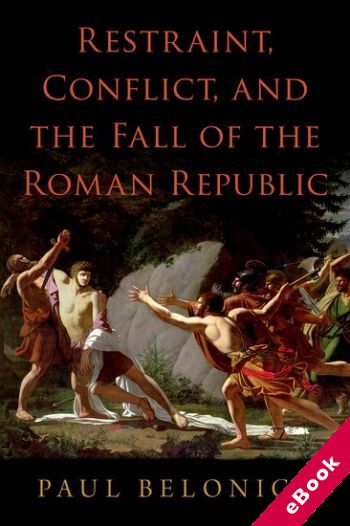
Strongly-held values can stabilize a society. They can also splinter it. In Restraint, Conflict, and the Fall of the Roman Republic, Paul Belonick explores the moral paradoxes of Republican Rome. He describes how aristocrats engaged in "performative politics," aggressively seeking self-advancement with a competitiveness that fueled the expansion of an empire. But, paradoxically, Roman orators and authors also emphasized the need for self-control, moderation, and temperance. Scholars have long suggested that this moral obsession with self-control was merely a social marker of aristocratic status, but Belonick argues that the Roman focus on self-control solidified their peculiar, competitive, semi-formal government.
Belonick then considers how values of restraint could both stabilize and de-stabilize Rome's political system. As conflicts arose over how to apply these values to novel circumstances, competitors saw each other as desecrating Republican principles and therefore as targets to be eradicated. Belonick illustrates both sides of the Roman paradox: how values of self-control legitimized the Romans' competition and supported their fluid social structure and political institutions—and then tore the Republic apart. Restraint, Conflict, and the Fall of the Roman Republic presents a fresh perspective on the collapse of one of the most prominent societies in history.










