Wildy Logo
(020) 7242 5778
enquiries@wildy.com

Book of the Month

Cover of 4 Stone Buildings on Liquidators

4 Stone Buildings on Liquidators

Edited by: Andrew de Mestre KC
Price: £289.00

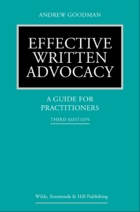
Effective Written Advocacy:
A Guide for
Practitioners 3rd


 Andrew Goodman


Welcome to Wildys

Watch


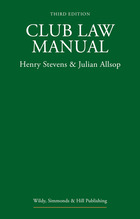
Club Law Manual
3rd ed


 Henry Stevens
Julian Allsop


Offers for Newly Called Barristers & Students

Special Discounts for Newly Called & Students

Read More ...


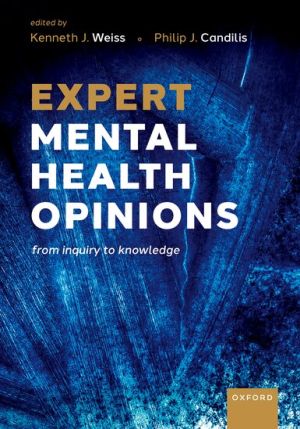
Expert Mental Health Opinions: From Inquiry to Knowledge

Edited by: Kenneth J. Weiss, Phillip J. Candilis

ISBN13: 9780197787892
To be Published: December 2026
Publisher: Oxford University Press USA
Country of Publication: USA
Format: Hardback
Price: £78.00


Courtroom experts provide judges and juries with evidence qualified by knowledge, skills, experience, training, and education. Mental health professionals, in particular, shed light on fraught questions like violence, sex, addiction, custody, and other value-laden issues. This work requires them to make connections between what constitutes disease and how the law recognizes it, though there is no universal guidance linking the two. Under oath, these experts are asked to assert "reasonable scientific certainty"—a legal term about truth and belief rooted in the philosophical question of how we derive knowledge.

Expert Mental Health Opinions: From Inquiry to Knowledge explores the methods of science and philosophy that build toward expertise. Drawing from the perspectives of dozens of international mental health practitioners, the book outlines the evolution of a psychiatric theory of knowledge, explores where this theory may falter, and charts developing frameworks of knowledge in forensic mental health. These distinct viewpoints create a multifaceted view of the epistemological debates among forensic professionals to determine how they come to know what they know. Drawing from statutes, professional standards, and legal precedents, alongside medical knowledge, behavioral science, ethics, and philosophy, Expert Mental Health Opinions is a significant contribution to an ongoing discussion that affects all legal systems which require expert testimony.

Subjects:
Mental Health Law
Contents:
Foreword: Back to Basics
Stephen J. Morse
Introduction
Kenneth J. Weiss and Philip J. Candilis
Section 1: History and evolution of a psychiatric theory of knowledge
Chapter 1: Forensic Epistemology: How Truth and Belief become Knowledge
Philip J. Candilis
Chapter 2: Fact vs. Opinion in Early Psychiatric Testimony
Joel P. Eigen
Chapter 3: Trial and Error in Mental Health Testimony: From Phrenology to Psychoanalysis
Kenneth J. Weiss
Chapter 4: Judge Bazelon's Grand Experiment in Epistemology
Kenneth J. Weiss
Chapter 5: Securing Social Justice: A Recommitment to Ethics in Forensic Psychiatry
Rebecca Brendel and Trevor Ma
Chapter 6: Epistemic Disagreement in Mental Health: Research and Practice - Tony Ward, Jacqueline Sullivan, and Russil Durrant
Chapter 7: Epistemic Disagreement in Mental Health: A Procedural Model
Tony Ward, Jacqueline Sullivan, and Russil Durrant
Chapter 8: Overcoming Bias
Kelso Cratsley and Ulrich Koch
Chapter 9: How "Folk Psychology" Has Contaminated Forensic Mental Health Law: The Powers of Heuristics and the Fraudulence of "Ordinary Common Sense"
Michael L. Perlin, Heather Ellis Cucolo, and Naomi M. Weinstein

Section 2: Current Challenges in Acquiring Knowledge for Expert Testimony
Chapter 10: (Guarding Against) Gender Bias in Forensic Evaluations - Susan Hatters Friedman, Renee M. Sorrentino, and Ryan C.W. Hall
Chapter 11: Misogyny, Sexual Violence and Missing Forensic Data: A Feminist Theory of Knowledge
Julia Curcio Alexander
Chapter 12: Beyond a Buzzword: "Trauma-Informed" Forensic Mental Health Assessment and Implications for Knowledge, Procedures, and Formulation
Julie Goldenson and Terry Kukor
Chapter 13: Structured Assessments As Epistemic Aids to Mental Health Testimony
Charles L. Scott
Chapter 14: Violence Risk Assessment in Mental Health: On Being Uncertain About Being Uncertain
Alec Buchanan
Chapter 15: Mental Disorder or Moral Depravity? A Clinical and Epistemic Distinction
Rocksheng Zhong and Dominic Sisti

Section 3: New Directions in the Application of Epistemology to Forensic Mental Health Assessments
Chapter 16: You're Probably Thinking about the Brain All Wrong
Octavio Choi
Chapter 17: Assessing Trauma Narratives of Asylum Seekers
Alisa R. Gutman and Jennifer McQuaid
Chapter 18: Cultural Considerations in Competence-to-Stand-Trial Cases for Experts
Neil Krishan Aggarwal
Chapter 19: Invoking Behavioral Genetics in Criminal Mitigation: What Can Experts Reasonably Say?
Kenneth J. Weiss, Alisa R. Gutman, and Wade H. Berrettini
Chapter 20: Reflections on a Career in Observation
Helen Morrison
Chapter 21: Interrogation Techniques and Truth-Seeking
David A. Sonenshein, Andy Griffiths, and Eric Shepherd
Chapter 22: The Best Interests of the Child Evaluation That Took Two and a Half Years to Complete: A Psychodynamic Formulation
Linda Gunsberg
Chapter 23: Actigraphy, Artificial Intelligence, and Applications to Forensic Psychiatry
Kimberly S. Resnick and Vikram Kumar
Chapter 24: The Maori Way of Knowledge
Kiri Prentice
Index