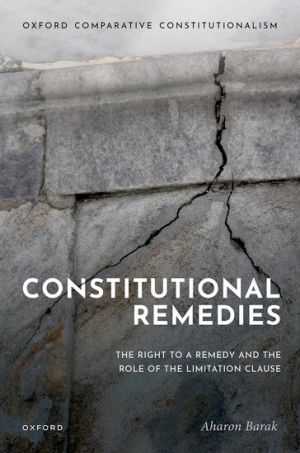
Constitutional Remedies by Aharon Barak presents a comprehensive theory of the legal consequences that follow from violations of constitutional norms. Drawing on comparative constitutional law, judicial practice, and decades of jurisprudential reflection, this work examines one of the most important yet underdeveloped areas of modern constitutionalism: the doctrine of constitutional remedies.
The book addresses a central question confronting constitutional courts worldwide: once a court determines that legislation or governmental action violates the constitution, what remedy should follow? Moving beyond the traditional model of nullification, Barak analyzes a wide range of constitutional responses, including reading-in, severance, restitution, damages, declaratory relief, suspended invalidity, and mandatory orders including declarations of unconstitutionality and invalidity, suspended invalidity, reading in, severance, restitution, damages, and mandatory orders directed at legislatures and public authorities.
At the heart of the analysis lies a unifying thesis: the remedy for the violation of a constitutional right is itself a constitutional right. Building on the principle ubi ius, ibi remedium—where there is a right, there is a remedy—the argument shows that constitutional remedies must themselves satisfy the principles of proper purpose and proportionality. The discussion, therefore, balances the effective protection of rights with broader constitutional considerations, including the rights of third parties, the institutional limitations of courts, separation of powers, constitutional dialogue, and the public interest in good governance. The volume also extends the analysis to statutes that violate institutional constitutional norms and to unconstitutional constitutional amendments.