
The eBooks we sell are sold as a single-user licence and are intended for the end user only.
The sale of some eBooks are restricted to certain countries. To alert you to such restrictions, please select the country of the billing address of your credit or debit card you wish to use for payment.
For further information see https://www.wildy.com/ebook-formats
Once the order is confirmed an e-mail will be sent to you to allow you to download the eBook. For UK purchases this will be automatic. For purchases outside the UK a member of staff will need to confirm the sale. (Staff are available to do this during normal business hours, Mon-Fri 8:30-17:00 UK time)
All eBooks are supplied firm sale and cannot be returned. If you believe there is a fault with your eBook then contact us on ebooks@wildy.com and we will help in resolving the issue. This does not affect your statutory rights.
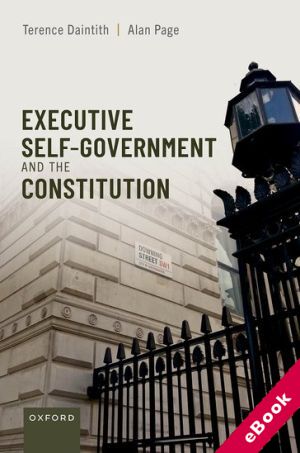
Over the last 25 years, UK governments have faced a series of challenges and changes of an intensity almost unprecedented in peacetime: some thrust upon them, some of their own making. Developments whose impact on the executive's place in the constitution are analysed in this volume include the global financial crisis in 2007/08, the 1997 Labour Government's programme of constitutional reform, the unexpected referendum result on withdrawal from the EU in 2016, the COVID-19 pandemic, the UK's withdrawal from the EU in 2020, and the energy and cost of living crisis that followed Russia's invasion of Ukraine in 2022.
The volume's conception of the UK's executive government is of an autonomous actor within the constitution, endowed with significant discretion in relation to its own organisation and modes of operation. By examining how governments have responded to those developments—through the reform of executive institutions and their deployment of the essential governmental resources of people, money, laws, and information—, Executive Self-Government and the Constitution opens a window on the internal operations of the contemporary executive and permits an assessment of the resilience of its key constitutional characteristics.
Building on the analysis of their original leading work The Executive in the Constitution (OUP 1999), Executive Self-Government and the Constitution assesses how the economic and political turbulence faced by successive governments since 1997 has affected its key constitutional features.










