The eBooks we sell are sold as a single-user licence and are intended for the end user only.
The sale of some eBooks are restricted to certain countries. To alert you to such restrictions, please select the country of the billing address of your credit or debit card you wish to use for payment.
For further information see https://www.wildy.com/ebook-formats
Once the order is confirmed an e-mail will be sent to you to allow you to download the eBook. For UK purchases this will be automatic. For purchases outside the UK a member of staff will need to confirm the sale. (Staff are available to do this during normal business hours, Mon-Fri 8:30-17:00 UK time)
All eBooks are supplied firm sale and cannot be returned. If you believe there is a fault with your eBook then contact us on ebooks@wildy.com and we will help in resolving the issue. This does not affect your statutory rights.
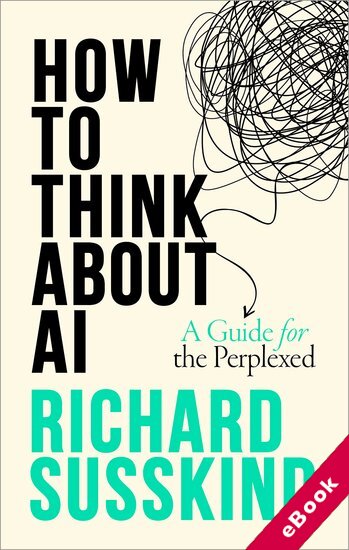
Revealing the unfolding story of Artificial Intelligence, Richard Susskind presents a short non-technical guide that challenges us to think differently about AI. Susskind brings AI out of computing laboratories, big tech companies, and start-ups - and into everyday life.
In recent years, and certainly since the launch of ChatGPT, there has been massive public and professional interest in Artificial Intelligence. But people are confused about what AI is, what it can and cannot do, what is yet to come, and whether AI is good or bad for humanity and civilisation - whether it will provide solutions to mankinds major challenges or become our gravest existential threat. There is also confusion about how we should regulate AI and where we should draw moral boundaries on its use.
In How To Think About AI, Richard Susskind draws on his experience of working on AI since the early 1980s. For Susskind, balancing the benefits and threats of artificial intelligence is the defining challenge of our age. He explores the history of AI and possible scenarios for its future. His views on AI are not always conventional. He positions ChatGPT and generative AI as no more than the latest chapter in the ongoing story of AI and claims we are still at the foothills of developments. He argues that to think responsibly about the impact of AI requires us to look well beyond todays technologies, suggesting that not-yet-invented technologies will have far greater impact on us in the 2030s than the tools we have today. This leads Susskind to discuss the possibility of conscious machines, magnificent new AI-enabled virtual worlds, and the impact of AI on the evolution of biological humans.