
The eBooks we sell are sold as a single-user licence and are intended for the end user only.
The sale of some eBooks are restricted to certain countries. To alert you to such restrictions, please select the country of the billing address of your credit or debit card you wish to use for payment.
For further information see https://www.wildy.com/ebook-formats
Once the order is confirmed an e-mail will be sent to you to allow you to download the eBook. For UK purchases this will be automatic. For purchases outside the UK a member of staff will need to confirm the sale. (Staff are available to do this during normal business hours, Mon-Fri 8:30-17:00 UK time)
All eBooks are supplied firm sale and cannot be returned. If you believe there is a fault with your eBook then contact us on ebooks@wildy.com and we will help in resolving the issue. This does not affect your statutory rights.
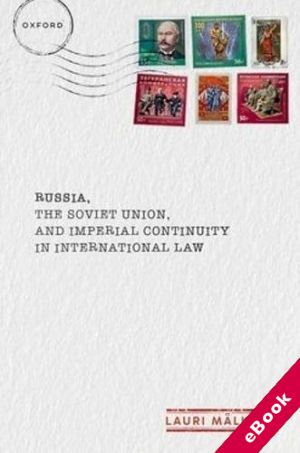
Russia, the Soviet Union, and Imperial Continuity in International Law explores the history of imperial ideas and practices in Russian and Soviet engagements with international law. This volume traces the role of international legal doctrines and arguments in facilitating the expansion of the Russian Empire, their transition into Soviet Russia post-1917, and their use after the disintegration of the Soviet Union in 1991.
Particular attention is paid to Russian and Soviet international legal doctrines concerning the termination of treaties (clausula rebus sic stantibus), identity and continuity of Russia in the context of state succession, hegemonic doctrines such as the great power status of Russia (or the Soviet Union), and various interpretations of balance of power and spheres of influence, including the doctrine of socialist international law. In building its narrative, the book draws extensively on previously under-studied international law periodicals published in Russia and the Soviet Union, including the 'Soviet Yearbook of International Law', 'Soviet State and Law' and 'Moscow Journal of International Law'.










