
Wildy Logo
(020) 7242 5778
enquiries@wildy.com

Book of the Month

Cover of McMeel on the Construction of Contracts: Interpretation, Implication and Rectification

McMeel on the Construction of Contracts: Interpretation, Implication and Rectification

Price: £225.00

Land Registration Manual
4th ed


 Ash Jones


Welcome to Wildys

Watch


Judicial Cooperation in Commercial Litigation 3rd ed (The British Cross-Border Financial Centre World)


 Ian Kawaley, David Doyle, Shade Subair Williams


Offers for Newly Called Barristers & Students

Special Discounts for Newly Called & Students

Read More ...


Secondhand & Out of Print

Browse Secondhand Online

Read More...


2025-6 Christmas and New Year Closing

We are now closed for the Christmas and New Year period, returning on Monday 5th January 2026. Orders placed during this time will be processed upon our return on 5th January.

Hide this message

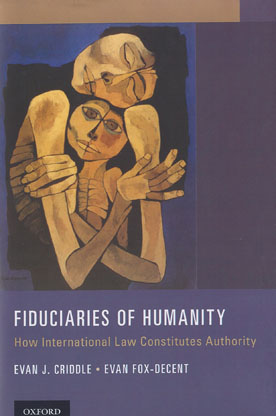
Fiduciaries of Humanity: How International Law Constitutes Authority


ISBN13: 9780199397921
Published: October 2016
Publisher: Oxford University Press USA
Country of Publication: USA
Format: Hardback
Price: £125.00


Despatched in 4 to 6 days.

Public international law has embarked on a new chapter. Over the past century, the classical model of international law, which emphasized state autonomy and interstate relations, has gradually ceded ground to a new model. Under the new model, a state's sovereign authority arises from the state's responsibility to respect, protect, and fulfill human rights for its people.

In Fiduciaries of Humanity: How International Law

Constitutes Authority, Evan J. Criddle and Evan Fox-Decent argue that these developments mark a turning point in the international community's conception of public authority.

In contrast to the receding classical model of public international law, which assumes an abiding tension between a state's sovereignty and principles of state responsibility, the fiduciary theory reconciles state sovereignty and responsibility by explaining how a state's obligations to its people are constitutive of its legal authority under international law.

The authors elaborate and defend the fiduciary model while exploring its application to a variety of current topics and controversies, including human rights, emergencies, the treatment of detainees in counterterrorism operations, humanitarian intervention, and the protection of refugees fleeing persecution.


Subjects:
Public International Law
Contents:
Acknowledgments
1. The Fiduciary Character of Sovereignty
I Introduction
II The Classical Model of Sovereignty
III From Classical Sovereignty to Relational Sovereignty
IV The Fiduciary Model of Sovereignty
V The Legal Structure of Fiduciary Relationships
VI The Moral Foundations of Fiduciary Obligation
VII A Kantian Theory of Fiduciary Sovereignty
VIII Lockean and Razian Theories of Fiduciary Sovereignty
IX The Fiduciary Constitution of International Law
X Summary of the Argument
2. Creating Fiduciary States
I Introduction
II Constituting Fiduciary States
III Distributing Sovereignty
IV Recognizing Fiduciary States
V A Deliberative Theory of State Recognition
VI Conclusion
3. Human Rights and Jus Cogens
I Introduction
II Developing Jus Cogens and International Human Rights Law
III In Search of a Theory
IV Fiduciary States and International Norms
V The Questions Revisited
VI Objections to the Fiduciary Theory
VII Conclusion
4. FIDUCIARY STATES IN EMERGENCIES
I Introduction
II International Law's Emergency Constitution
III Fiduciary States, Human Rights, and Emergencies
IV Carl Schmitt's Challenge
V The Fiduciary Theory's Response
VI The Role of Courts and International Institutions
VII On the Relationship Between Law and Power
VIII Conclusion
5. FIDUCIARY STATES IN ARMED CONFLICT
I Introduction
II Fiduciary States' Responsibility To Protect
III Fiduciary Realism
IV Fiduciary States as Trustees of Humanity
V International Armed Conflict
VI Internal Armed Conflict
VII Asymmetric Self-Defense
VIII Occupation
IX Humanitarian Intervention
X Conclusion
6. COSMOPOLITAN CITIZENSHIP: DETAINING FOREIGN NATIONALS
I Introduction
II A Fiduciary Account of Combatant Detention
III The Geneva Conventions
IV Black Holes
V The Problem of Classified Evidence
VI Conclusion
7. COSMOPOLITAN CITIZENSHIP: THE RIGHT TO REFUGE
I Introduction
II The Development of International Refugee Law
III Humanitarianism, Human Rights, and Territory
IV A Fiduciary Interpretation of International Refugee Law
V Conclusion
8. INTERNATIONAL INSTITUTIONS AS TRUSTEES OF HUMANITY
I Introduction
II International Institutions as Indirect Trustees of Humanity
III International Institutions as Direct Trustees of Humanity
IV The Authority and Obligations of International Institutions
V The Relationship Between International and Domestic Institutions
VI Conclusion and Future Directions
Index







