Wildy Logo
(020) 7242 5778
enquiries@wildy.com

Book of the Month

Cover of McMeel on the Construction of Contracts: Interpretation, Implication and Rectification

McMeel on the Construction of Contracts: Interpretation, Implication and Rectification

Price: £225.00

Land Registration Manual
4th ed


 Ash Jones


Welcome to Wildys

Watch


Judicial Cooperation in Commercial Litigation 3rd ed (The British Cross-Border Financial Centre World)


 Ian Kawaley, David Doyle, Shade Subair Williams


Offers for Newly Called Barristers & Students

Special Discounts for Newly Called & Students

Read More ...


Secondhand & Out of Print

Browse Secondhand Online

Read More...


2025-6 Christmas and New Year Closing

We are now closed for the Christmas and New Year period, returning on Monday 5th January 2026. Orders placed during this time will be processed upon our return on 5th January.

Hide this message

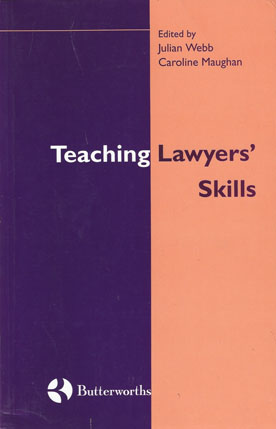
Teaching Lawyers' Skills


ISBN13: 9780406052162
ISBN: 0406052166
Published: May 1996
Publisher: LexisNexis Butterworths
Country of Publication: UK
Format: Paperback
Price: Out of print


Out of Print

Here is a law teacher's resource book that comprises a collection of articles on key aspects of teaching legal skills, each written by a noted expert in their field.

Subjects:
Legal Skills and Method
Contents:
Introduction.
Part I: The Learning Process.
How students learn.
Teaching, learning and the socialisation of lawyers.
Why theory matters: challenging the dominant espistemology of legal education.
Part II: Approaches to Legal Skills Teaching.
Experiential learning in law.
A problem-based learning approach to skills education.
Integrating legal skills into the undergraduate curriculum.
Development an undergraduate clinical programme - a case study.
Skills teaching on the LPC.
Learning the art of lawyering: developing a reflective practicum in undergraduate legal education.
Developing the reflective practicum in vocational education.
Part III: Competency, Assessment & Evaluation.
Defining standards of legal competence.
Developing a general theory of competence.
Creating inference rules for assessing competence.
Peer and self-assessment techniques.
The use of learning diaries in clinical simulation.
Student evaluation of skills courses: The bar's experience.









