
Wildy Logo
(020) 7242 5778
enquiries@wildy.com

Book of the Month

Cover of Judicial Review Handbook

Judicial Review Handbook

Price: £250.00

Land Registration Manual
4th ed


 Ash Jones


Welcome to Wildys

Watch


Judicial Cooperation in Commercial Litigation 3rd ed (The British Cross-Border Financial Centre World)


 Ian Kawaley, David Doyle, Shade Subair Williams


Offers for Newly Called Barristers & Students

Special Discounts for Newly Called & Students

Read More ...


Secondhand & Out of Print

Browse Secondhand Online

Read More...


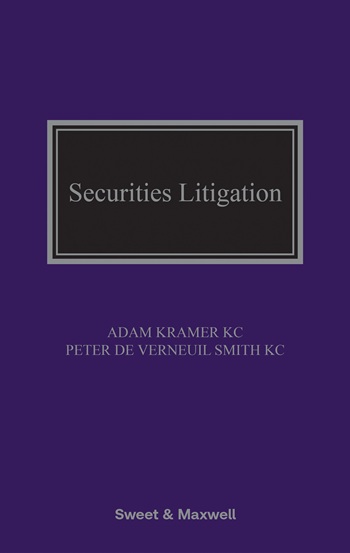
Securities Litigation


ISBN13: 9780414130821
To be Published: June 2026
Publisher: Sweet & Maxwell Ltd
Country of Publication: UK
Format: Hardback
Price: £255.00


Also available as
£216.75
£281.80

Securities Litigation is the first practitioner textbook setting out the law on the various claims available in England and Wales in relation to issued securities (the dedicated statutory claims under s90 and s90A FSMA 2000, as well as the general torts available in this context), building on the growing body of specific securities litigation case law, as well as the case law in analogous areas. This ground-breaking book will cover not only the requirements of the substantive causes of action but also, equally important in this typically class action/group type of claim, the procedural requirements that have come to the fore in the high-profile securities claims of recent years (questions of standing, limitation, split trials, disclosure etc). The authors are experienced barrister practitioners in securities disputes (a hot area where many litigators are keenly interested, but few have actual experience).

Drawing on wider/analogous case law (because of the lack of clear case law guidance), the authors provide expert guidance on key topics including:


  • In respect of s.90: whether there is a reliance requirement, whether those who purchase securities in the secondary market have standing to bring a claim, what amounts to misleading statements, which individuals within a corporate defendant are to be considered relevant for attribution of knowledge, the scope of the ‘no negligence defence’ when and how damages are likely to be assessed (whether the negligence or fraud measure applies and how the court is work out matching of thousands of transactions involving buying and selling within a relevant period).
  • For s.90A: what counts as an interest in securities (how far removed can the interest be?), how can a claimant demonstrate reliance (does indirect reliance work and could a tracker fund bring a claim?), who counts a PDMR, what is the scope of the liability for omissions (what is the required information which must be included), what is the scope of the dishonest delay claim, when and how damages are likely to be assessed.
  • Comparisons to the learning in other jurisdictions will be made in order to show the potential paths the English Courts may adopt, with an assessment of whether such development is likely (fraud on the market in USA, market-based causation in Australia, for instance). The authors will also examine how securities claims are typically built by a claimant group, the economics and legal issues which arise, the use of Group Litigation Orders (GLO), alternatives to GLO and specific procedural law applying to securities claims (such as limitation law and funding disclosure).

Subjects:
Banking and Finance
Contents:
Foreword by Mr Justice Michael Green
Preface
1. The securities context
2. Regulation
3. Structuring in securities litigation
4. The causes of action
5. Standing
6. False statements, omissions and dishonest delay
7. S90A reliance
8. The s90/Reg 30 defence of claimant knowledge of truth, and possible reliance requirement
9. S90/Reg 30 reasonable belief/dishonesty
10. PDMR knowledge/dishonesty under s90A
11. Causation and loss
12. Limitation
13. Split trials and preliminary issues
14. Disclosure and witness evidence
15. Test claimants
16. Expert evidence
17. Costs and litigation Funding
18. FCA enforcement and remedies
19. Insurance
20. Do claimants have a duty to bring a claim?








