
The eBooks we sell are sold as a single-user licence and are intended for the end user only.
The sale of some eBooks are restricted to certain countries. To alert you to such restrictions, please select the country of the billing address of your credit or debit card you wish to use for payment.
For further information see https://www.wildy.com/ebook-formats
Once the order is confirmed an e-mail will be sent to you to allow you to download the eBook. For UK purchases this will be automatic. For purchases outside the UK a member of staff will need to confirm the sale. (Staff are available to do this during normal business hours, Mon-Fri 8:30-17:00 UK time)
All eBooks are supplied firm sale and cannot be returned. If you believe there is a fault with your eBook then contact us on ebooks@wildy.com and we will help in resolving the issue. This does not affect your statutory rights.
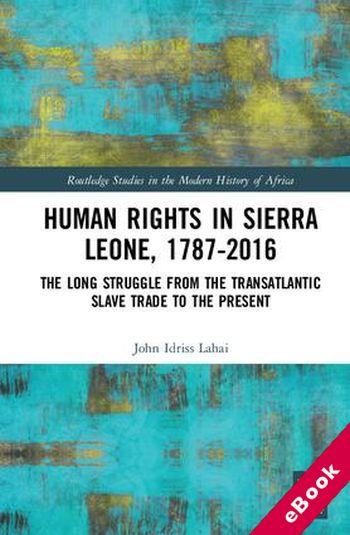
This book offers an up-to-date, comprehensive interdisciplinary analysis of the multifaceted and evolving experiences of human rights in Sierra Leone between the years 1787 and 2016. It provides balanced coverage of the local and international conditions that frame the socio-cultural, political, and economic context of human rights: its rise and fall, and concerns for the broader engendered issues of the transatlantic slave trade, colonialism, women’s struggle for recognition, constitutional development, political independence, war, and transitional justice
(as well as "contributive justice," which the author introduces to explain the consequences of the problems of the temporal nature of transitional justice, and the crisis of donor fatigue towards peacebuilding activities), local government, democracy, and constitutional reforms within Sierra Leone. While acknowledging the profound challenges associated with the promotion of human rights in an environment of uncertainty, political fragility, lawlessness, and deprivation, John Idriss Lahai sheds light on the often-constructive engagement of the people of Sierra Leone with a variety of societal conditions, adverse or otherwise, to influence constitutional change, the emergent post-conflict discourse on "contributive justice," and acceptable human rights practice. This book will be of interest to scholars in West African history, legal history, African studies, peace and conflict studies, human rights and transitional justice.










