
The eBooks we sell are sold as a single-user licence and are intended for the end user only.
The sale of some eBooks are restricted to certain countries. To alert you to such restrictions, please select the country of the billing address of your credit or debit card you wish to use for payment.
For further information see https://www.wildy.com/ebook-formats
Once the order is confirmed an e-mail will be sent to you to allow you to download the eBook. For UK purchases this will be automatic. For purchases outside the UK a member of staff will need to confirm the sale. (Staff are available to do this during normal business hours, Mon-Fri 8:30-17:00 UK time)
All eBooks are supplied firm sale and cannot be returned. If you believe there is a fault with your eBook then contact us on ebooks@wildy.com and we will help in resolving the issue. This does not affect your statutory rights.
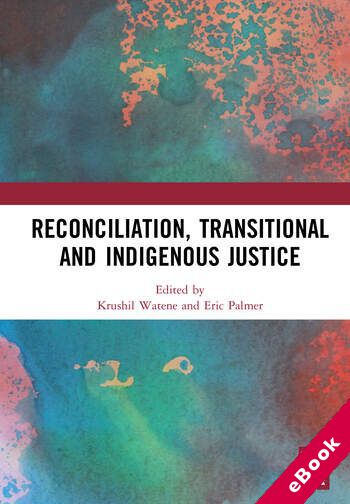
Reconciliation, Transitional and Indigenous Justice presents fifteen reflections upon justice twenty years after the Truth and Reconciliation Commission of South Africa introduced a new paradigm for political reconciliation in settler and post-colonial societies.
The volume considers processes of political reconciliation, appraising the results of South Africa's Commission, of the recently concluded Truth and Reconciliation Commission of Canada and of the on-going process of the Waitangi Tribunal of Aotearoa New Zealand. Contributors discuss the separate politics of Indigenous resurgence, linguistic justice, environmental justice and law. Further contributors present a theoretical symposium focused on The Conceptual Foundations of Transitional Justice, authored by Colleen Murphy, who provides a response to their comments. Indigenous and non-Indigenous voices from four regions of the world are represented in this critical assessment of the prospects for political reconciliation, for transitional justice and for alternative, nascent conceptions of just politics.
Radically challenging assumptions concerning sovereignty and just process in the current context of settler-colonial states, Reconciliation, Transitional and Indigenous Justice will be of great interest to scholars of Ethics, Indigenous Studies, Transitional Justice and International Relations more broadly. With the addition of one chapter from The Round Table, the chapters in this book were originally published as a special issue in the Journal of Global Ethics.











