
The eBooks we sell are sold as a single-user licence and are intended for the end user only.
The sale of some eBooks are restricted to certain countries. To alert you to such restrictions, please select the country of the billing address of your credit or debit card you wish to use for payment.
For further information see https://www.wildy.com/ebook-formats
Once the order is confirmed an e-mail will be sent to you to allow you to download the eBook. For UK purchases this will be automatic. For purchases outside the UK a member of staff will need to confirm the sale. (Staff are available to do this during normal business hours, Mon-Fri 8:30-17:00 UK time)
All eBooks are supplied firm sale and cannot be returned. If you believe there is a fault with your eBook then contact us on ebooks@wildy.com and we will help in resolving the issue. This does not affect your statutory rights.
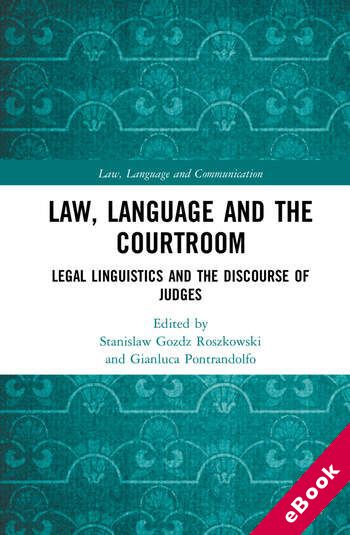
This book explores the language of judges. It is concerned with understanding how language works in judicial contexts. Using a range of disciplinary and methodological perspectives, it looks in detail at the ways in which judicial discourse is argued, constructed, interpreted and perceived. Focussing on four central themes - constructing judicial discourse and judicial identities, judicial argumentation and evaluative language, judicial interpretation and clarity in judicial discourse, the book’s ultimate goal is to provide a comprehensive and in-depth overview of current critical issues of the role of language in judicial settings. Written by contributors from legal linguists, lawyers, legal scholars, legal practitioners, legal translators, and anthropologists, the work explores patterns of linguistic organization and use in judicial institutions and analyzes language as an instrument for understanding both the judicial decision-making process and its outcome.
The book will be an invaluable resource for scholars in legal linguistics and those specializing in judicial argumentation and reasoning and forensic linguists interested in the use of language in judicial settings.










