
The eBooks we sell are sold as a single-user licence and are intended for the end user only.
The sale of some eBooks are restricted to certain countries. To alert you to such restrictions, please select the country of the billing address of your credit or debit card you wish to use for payment.
For further information see https://www.wildy.com/ebook-formats
Once the order is confirmed an e-mail will be sent to you to allow you to download the eBook. For UK purchases this will be automatic. For purchases outside the UK a member of staff will need to confirm the sale. (Staff are available to do this during normal business hours, Mon-Fri 8:30-17:00 UK time)
All eBooks are supplied firm sale and cannot be returned. If you believe there is a fault with your eBook then contact us on ebooks@wildy.com and we will help in resolving the issue. This does not affect your statutory rights.
Due to a technical issue some ebooks are not available to order.
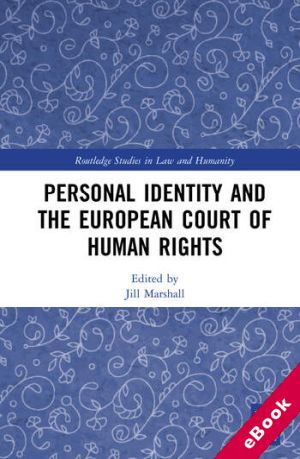
In this new and burgeoning field in legal and human rights thought, this edited collection explores, by reference to applied philosophy and case law, how the European Court of Human Rights (ECtHR) has developed and presented a right to personal identity, largely through interpretation of Article 8 of the European Convention on Human Rights.
Divided into three parts, the collection interrogates: firstly, the construction of personal identity rights at the ECtHR; secondly, whose identity rights are protected; and thirdly, the limits of identity rights. The collection is the first in the Routledge Studies in Law and Humanity series. Contributions from nine leading and emerging legal scholars from the UK, Ireland and continental Europe explore how the right has developed, rights to identity and marriage, LGBTI+, persons with disabilities, religious and cultural issues and critical perspectives on the social construction and framing of the right.
The collection is primarily aimed at scholars and advanced students, particularly of human rights law and its theory, Jurisprudence and Philosophy of Law, and those interested in ECtHR jurisprudence, and those interested in the connection between theories of inclusion, belonging and rights, including human rights lawyers.










