
The eBooks we sell are sold as a single-user licence and are intended for the end user only.
The sale of some eBooks are restricted to certain countries. To alert you to such restrictions, please select the country of the billing address of your credit or debit card you wish to use for payment.
For further information see https://www.wildy.com/ebook-formats
Once the order is confirmed an e-mail will be sent to you to allow you to download the eBook. For UK purchases this will be automatic. For purchases outside the UK a member of staff will need to confirm the sale. (Staff are available to do this during normal business hours, Mon-Fri 8:30-17:00 UK time)
All eBooks are supplied firm sale and cannot be returned. If you believe there is a fault with your eBook then contact us on ebooks@wildy.com and we will help in resolving the issue. This does not affect your statutory rights.
The rapid globalization of capital markets has increased attention toward examining the quality of the disclosure practices implemented by companies, as internationalization and globalization are the most important motives of the harmonization of financial statements preparation and presentation. Given the expansion of trade and the openness to foreign capital markets, investment decisions became not limited only for local users, but also international users may need to access the financial information. The issuance of International Financial Reporting Standards (IFRS) to be used throughout the world aims to improve the comparability and understandability of financial statements, and hence, to enhance investment decisions through helping investors across the borders to invest in multinational companies. Although fluid and under-developed institutional arrangements remain central features of emerging markets, ensuring effective corporate governance mechanisms would indeed support companies in complying with IFRS - the latter imposes a challenge for companies operating in emerging markets.
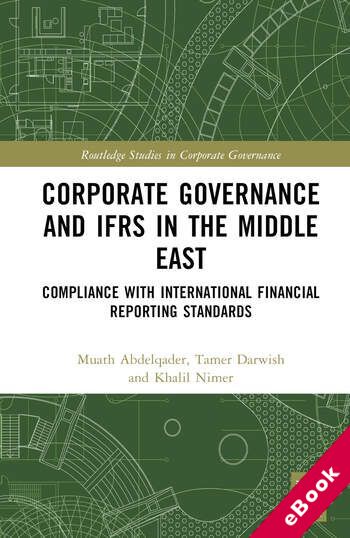
This book evaluates the differences in the level of compliance with IFRS across the GCC states, exploring the impact of corporate governance on the level of compliance with IFRS and presenting an empirical analysis of companies across the GCC. It makes an important contribution by providing a detailed empirical analysis of the interplay between corporate governance and IFRS in emerging market setting and highlights the way for future research. It will provide international business, management, and accounting and finance students and senior practitioners with a completely new and updated guide to the work in the field of corporate governance and IFRS compliance in emerging markets.










