
Wildy Logo
(020) 7242 5778
enquiries@wildy.com

Book of the Month

Cover of Privacy as Property

Privacy as Property

Price: £95.00

Advocacy: A Practical
Guide 2nd ed


 Peter Lyons, Chris Taylor


Welcome to Wildys

Watch


Judicial Cooperation in Commercial Litigation 3rd ed (The British Cross-Border Financial Centre World)


 Ian Kawaley, David Doyle, Shade Subair Williams


Offers for Newly Called Barristers & Students

Special Discounts for Newly Called & Students

Read More ...


Secondhand & Out of Print

Browse Secondhand Online

Read More...


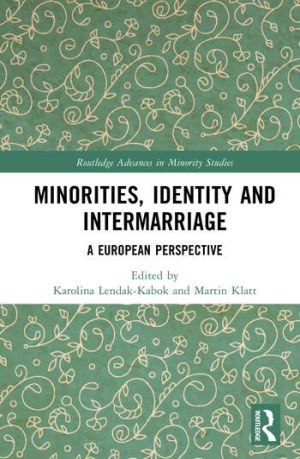
Minorities, Identity and Intermarriage A European Perspective

Edited by: Karolina Lendák-Kabók, Martin Klatt

ISBN13: 9781032914190
To be Published: July 2026
Publisher: Routledge
Country of Publication: UK
Format: Hardback
Price: £155.00


Intermarriages, uniting partners from diverse social, ethnic, religious, or racial backgrounds, play a pivotal and perhaps conflictual role in shaping group identities. Celebrated by some for fostering social integration, they are perceived by others within ethnic minority circles as a form of acculturation or even assimilation.

This volume delves into the intricate interplay between identity, kin-state identity policies, and intermarriage, particularly among national minorities. By weaving together historical analysis, autoethnography, and sociology, it aims to debunk the myth of homogeneity within European nation-states, spotlighting the rich diversity within minority groups. The book challenges the traditional view of minority groups as monolithic, instead revealing how intermarriage can blur the lines between different identities, thereby enriching our understanding of identity construction and group unity. It provides a nuanced examination of intermarriages that share citizenship yet differ in ethnic or national backgrounds—an area hitherto largely unexplored. The discussion extends to the effects of such unions on both personal and communal identities, addressing underlying tensions, stereotypes, and prejudices. The work further considers how these choices impact language, education, religious practices, and parenting within minority communities, ultimately strengthening the argument for intermarriage as a significant, transformative social practice.

The collection will be of interest to academics and researchers working in the areas of Anthropology, Law, Sociology and Minority Studies.


Subjects:
Human Rights and Civil Liberties
Contents:
Introduction
Karolina Lendák-Kabók and Martin Klatt

Part I: Changing Perspectives on Intermarriages through History
1. What’s Love Got to Do with It? From the Peril of Mixed Marriages to the Promise of Bilingual Families in Post-War Finland
Mats Wickström, Hanna Lindberg and Jutta Ahlbeck
2. Between Illegality and Approval: Three Cases of Roma Intermarriage in Moldavia, 1800–1855
Cristina Mocanu
3. Was it a Mixed Marriage? Legal Files from the Documentary Prose of Tibor Várady
Marija Mandić

Part II: State Policies around Intermarriages
4. Intermarriage and Multiethnicity among Spanish Roma: Transgressing Problematised Interethnic Divisions
Dan Rodríguez-García
5. Roma in mixed-ethnic partnerships and ethnic identification of their children in 1990, 2011 and 2022, in Hungary
Laura Szabó
6. Maneuvering between nationalizing policies: ethnically marked choices in the Ukrainian-Hungarian intermarriages in Transcarpathia, Ukraine
Patrik Tátrai, Viktória Ferenc, Julianna Kohut-Ferki, Katalin Kovály and József Molnár
7. Bridging the Divide: Interethnic Marriages in Bosnia and Herzegovina
Nađa Beglerović

Part III: Negotiating difference: culture, language and identity
8. The Dynamics of Ethnic Self-Identification and Belonging in Slovenian-Italian Minority Mixed Families
Mateja Sedmak and Maja Zadel
9. Marriage Across Borders
Erik Kühl and Martin Klatt
10. Building Commonalities and Belonging in Turkish-Kurdish intermarriages in Izmir, Turkey
Gül Özateşler Ülkücan
11. Remarks on Identity in Sorbian-German families in Upper Lusatia: Navigating the First Language as a Criterion for Ethnic Categorisation
Sara Mičkec
12. Kosovo: A Region without Intermarriages
Sanja Zlatanović

Part IV: Born into intermarriages: impact on children and youth
13. Romanian Mixed Families: From National to Transnational Identities
Áron Telegdi-Csetri and Viorela Ducu
14. Navigating Identity and Belonging: Young Adults from Mixed Serb-Hungarian Families in Serbia
Karolina Lendák-Kabók
15. How long should the Christmas tree be decorated? Autoethnographic Study on Growing up in Mixed Marriage Along Croatia-Montenegro Border
Jelena Seferović
16. A Study of Family Language Policy and Intercultural Communication in Estonian-Russian Mixed Households
Anastassia Zabrodskaja







