
The eBooks we sell are sold as a single-user licence and are intended for the end user only.
The sale of some eBooks are restricted to certain countries. To alert you to such restrictions, please select the country of the billing address of your credit or debit card you wish to use for payment.
For further information see https://www.wildy.com/ebook-formats
Once the order is confirmed an e-mail will be sent to you to allow you to download the eBook. For UK purchases this will be automatic. For purchases outside the UK a member of staff will need to confirm the sale. (Staff are available to do this during normal business hours, Mon-Fri 8:30-17:00 UK time)
All eBooks are supplied firm sale and cannot be returned. If you believe there is a fault with your eBook then contact us on ebooks@wildy.com and we will help in resolving the issue. This does not affect your statutory rights.
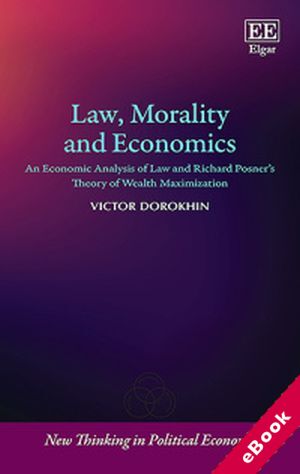
This book reconceptualizes wealth maximization in law and economics, proposing a revised framework that integrates cognitive and moral dimensions into institutional analysis. Victor Dorokhin argues that wealth maximization must be constrained by the moral intuitions and normative expectations inherent in human cognition.
The author expands upon the concept of moral costs, highlighting the often-overlooked ethical trade-offs in standard economic models. He assesses the foundations of legal reasoning from an interdisciplinary perspective, outlining a cognitively grounded alternative to utilitarian and contractarian frameworks in legal analysis. Drawing on insights from the Austrian school, legal philosophy, neuroscience, and a critical engagement with Richard Posner’s theory of wealth maximization, the chapters explore how institutions emerge not merely through rational design, but as responses to shared judgments about justice and legitimacy. The book also presents practical recommendations for legal policy, emphasizing the importance of aligning legal frameworks with the moral architecture of social agents.
Law, Morality and Economics is a valuable resource for scholars and students of legal economics and political economy. Providing normative guidelines and actionable policy suggestions, it is also beneficial for legal policy analysts and reformers.










