
The eBooks we sell are sold as a single-user licence and are intended for the end user only.
The sale of some eBooks are restricted to certain countries. To alert you to such restrictions, please select the country of the billing address of your credit or debit card you wish to use for payment.
For further information see https://www.wildy.com/ebook-formats
Once the order is confirmed an e-mail will be sent to you to allow you to download the eBook. For UK purchases this will be automatic. For purchases outside the UK a member of staff will need to confirm the sale. (Staff are available to do this during normal business hours, Mon-Fri 8:30-17:00 UK time)
All eBooks are supplied firm sale and cannot be returned. If you believe there is a fault with your eBook then contact us on ebooks@wildy.com and we will help in resolving the issue. This does not affect your statutory rights.
Due to a technical issue some ebooks are not available to order.
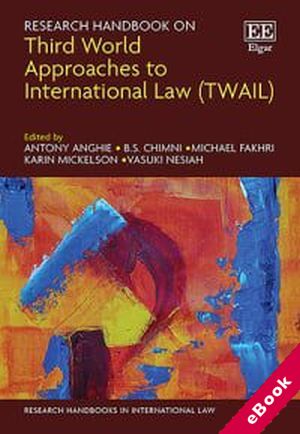
This Research Handbook provides a comprehensive overview of Third World Approaches to International Law (TWAIL) with chapters exploring different facets of TWAIL scholarship. It covers major doctrines and topics of international law, as well as TWAIL perspectives on central historical and theoretical debates.
Expert authors present key insights into various themes that intersect with international law including economics, post-colonialism, religion, development, treaties, and human rights. The Research Handbook underscores the cornerstone concepts of TWAIL and examines their relationship with intellectual traditions such as Marxism and feminism. Contributing authors outline TWAIL’s perspectives on core areas of international law such as customary international law, treaties and human rights, as well as important contemporary issues, including debt, climate change, and public health. Ultimately, the Research Handbook showcases an expanded and enriched vision of international law, assessing how alternate methodologies can lead to a fairer legal system.
Encompassing an authoritative overview of the legacy and future of TWAIL, this Research Handbook is of vital importance to scholars and students of international law, international relations, legal theory, and development studies. It is also an essential reference for lawyers and policymakers in the fiel










