
The eBooks we sell are sold as a single-user licence and are intended for the end user only.
The sale of some eBooks are restricted to certain countries. To alert you to such restrictions, please select the country of the billing address of your credit or debit card you wish to use for payment.
For further information see https://www.wildy.com/ebook-formats
Once the order is confirmed an e-mail will be sent to you to allow you to download the eBook. For UK purchases this will be automatic. For purchases outside the UK a member of staff will need to confirm the sale. (Staff are available to do this during normal business hours, Mon-Fri 8:30-17:00 UK time)
All eBooks are supplied firm sale and cannot be returned. If you believe there is a fault with your eBook then contact us on ebooks@wildy.com and we will help in resolving the issue. This does not affect your statutory rights.
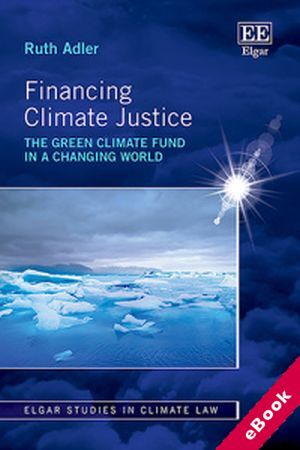
This timely book traces the evolution of the Green Climate Fund (GCF) since its establishment in 2010. Ruth Adler investigates whether it has the legitimacy necessary to substantially contribute to the achievement of the objectives of the Paris Agreement, including limiting the increase in global average temperature to less than 2°C above pre-industrial levels.
Adler conducts a comprehensive study of the performance of the GCF, and addresses gaps in the existing scholarship to analyse the Fund’s effectiveness. Taking a deep dive into its portfolio, she determines whether the funded projects and programs have been effective, and if they have achieved outcomes consistent with the principles of justice and equity. Chapters draw on performance reporting and independent evaluations, as well as annual reports and financial information, which indicate implementation challenges and delays. Adler ultimately argues that the Fund’s legitimacy could be enhanced through reforms to its governance and contributions from a broader range of donors.
This book is a crucial read for scholars and students of climate change, environmental law and public international law. It is also beneficial for practitioners and policymakers in climate policy and finance, as well as NGOs, climate activists and investors in the field.











