
The eBooks we sell are sold as a single-user licence and are intended for the end user only.
The sale of some eBooks are restricted to certain countries. To alert you to such restrictions, please select the country of the billing address of your credit or debit card you wish to use for payment.
For further information see https://www.wildy.com/ebook-formats
Once the order is confirmed an e-mail will be sent to you to allow you to download the eBook. For UK purchases this will be automatic. For purchases outside the UK a member of staff will need to confirm the sale. (Staff are available to do this during normal business hours, Mon-Fri 8:30-17:00 UK time)
All eBooks are supplied firm sale and cannot be returned. If you believe there is a fault with your eBook then contact us on ebooks@wildy.com and we will help in resolving the issue. This does not affect your statutory rights.
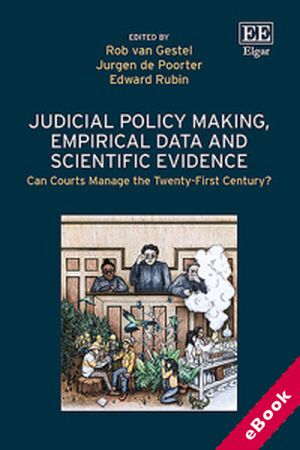
This book examines the uncertainties which arise when courts have to deal with complex empirical data and contested scientific evidence in public interest cases, but lack the necessary knowledge and training to do so. Expert contributors explore the strategies, methods and techniques applied by the courts to inform their decisions, reduce uncertainty and assist proportionality assessments.
Moving beyond mainstream legal thinking, which evaluates whether courts should engage with policy making, the contributors investigate the ways in which courts are actively interacting with this process. Chapters explore how courts are often hesitant to collect empirical data or scientific evidence and yet sometimes rely on this kind of evidence too easily when it is brought by self-interested litigants. The contributors present solutions to make courts less dependent on the adversarial system, revealing how courts are eager to avoid a battle of the sciences. They analyse the dependence of courts on legal principles, the procedural rules which distribute the burden of proof and ways of outsourcing complex factual issues to third party experts.
Judicial Policy Making, Empirical Data and Scientific Evidence is a vital resource for scholars and students of constitutional and administrative law, research methods and law and politics. It is also beneficial for practitioners dealing with cases involving empirical data and scientific evidence.










