
The eBooks we sell are sold as a single-user licence and are intended for the end user only.
The sale of some eBooks are restricted to certain countries. To alert you to such restrictions, please select the country of the billing address of your credit or debit card you wish to use for payment.
For further information see https://www.wildy.com/ebook-formats
Once the order is confirmed an e-mail will be sent to you to allow you to download the eBook. For UK purchases this will be automatic. For purchases outside the UK a member of staff will need to confirm the sale. (Staff are available to do this during normal business hours, Mon-Fri 8:30-17:00 UK time)
All eBooks are supplied firm sale and cannot be returned. If you believe there is a fault with your eBook then contact us on ebooks@wildy.com and we will help in resolving the issue. This does not affect your statutory rights.
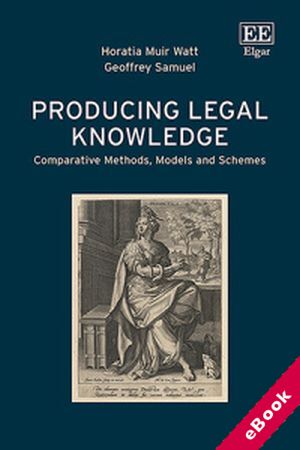
This thought-provoking book opens up a distinctive and original framework of analysis of the relationship between legal methodologies and the social and human sciences. Rich in implications both for comparative legal theory and for the understanding of legal reasoning in practice, it adopts a critical epistemological perspective by enlarging the focus of comparative legal studies and allowing for a much-needed decentering of conventional approaches to law across cultures and disciplines.
Using a novel lens, leading scholars Horatia Muir Watt and Geoffrey Samuel explore modes of knowledge, reasoning and veridiction that are usually taken for granted within the law. They investigate interdisciplinary insights from areas as diverse as algorithmic governance, symmetrical anthropology or cinema studies to suggest alternative knowledge frameworks better attuned to our culturally diverse world. Building on well known examples from Roman law, private international law and contemporary orientations in legal comparison, they highlight both the resistance of traditional legal epistemology to transformative moves in other fields as well as how other areas of knowledge incorporate in turn contributions from legal doctrines and juridical argument. These novel methodological approaches have significant implications both for comparative legal theory and the understanding of legal reasoning in practice.
Producing Legal Knowledge is a beneficial read for scholars and students of comparative legal studies and legal epistemology, particularly those interested in legal research methods.










