
The eBooks we sell are sold as a single-user licence and are intended for the end user only.
The sale of some eBooks are restricted to certain countries. To alert you to such restrictions, please select the country of the billing address of your credit or debit card you wish to use for payment.
For further information see https://www.wildy.com/ebook-formats
Once the order is confirmed an e-mail will be sent to you to allow you to download the eBook. For UK purchases this will be automatic. For purchases outside the UK a member of staff will need to confirm the sale. (Staff are available to do this during normal business hours, Mon-Fri 8:30-17:00 UK time)
All eBooks are supplied firm sale and cannot be returned. If you believe there is a fault with your eBook then contact us on ebooks@wildy.com and we will help in resolving the issue. This does not affect your statutory rights.
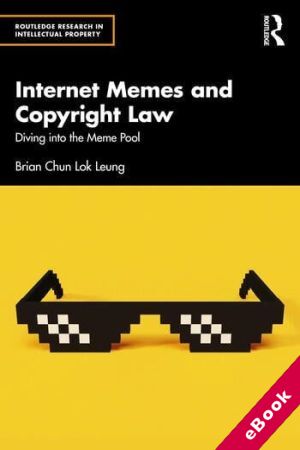
This book explores the intricate relationship between copyright law and internet meme culture, challenging an assumption that copyright is a barrier to digital creativity.
Using the lens of internet memes to analyse copyright law in the context of participatory remix culture, the book confronts a common perception that copyright is the "destroyer" of internet memes on social media platforms. Following the European Union’s Copyright Directive, widely known as the "Meme Ban," this book critically examines whether copyright might instead be reimagined to foster rather than inhibit re-creations that define internet meme culture. The book argues that this culture directly challenges copyright's core assumptions, and proposes a new, holistic approach to copyright that distinguishes between traditional and emergent forms of creative processes. Arguing for a flexible interpretation of copyright that limits private proprietary rights in the case of internet memes, it provides a legal framework to support socio-cultural discourse without undermining copyright's foundational principles. Covering core copyright concepts such as authorship, idea/expression, originality, fair dealing, and user rights, the book provides a compelling argument as to how copyright can adapt to the digital age as a protector of cultural expressions, ensuring that internet memes are not only preserved but celebrated.
The book will be of interest to researchers in the field of copyright law, the law of emerging technologies and intellectual property law.










